Blog

  • Family Support in Clinical Trials: A Clear Guide to Talking With Loved Ones

    Family Support in Clinical Trials: A Clear Guide to Talking With Loved Ones

    Family support in clinical trials plays an important role when someone is considering joining a study, especially during moments filled with uncertainty, questions, and emotional concerns. Deciding whether to participate in a clinical trial rarely affects just one person. It often impacts partners, parents, children, or caregivers who want reassurance and clarity.

    Strong family support in clinical trials helps individuals feel more confident, informed, and emotionally prepared when making participation decisions.

    Open communication helps replace fear with understanding. When families feel informed and included, conversations become more supportive, and decisions feel more confident and grounded.

    Why Family Support Matters in Clinical Trials

    Family support in clinical trials provides emotional stability during a time that can feel overwhelming. Loved ones often help individuals process information, ask thoughtful questions, and reflect on what participation might mean for daily life.

    When families are part of the conversation, decisions become shared rather than isolated. This shared understanding reduces stress, builds trust, and reassures everyone involved that the choice is thoughtful and informed. Hesitation is natural, and family involvement allows space for reflection without pressure.

    When family members understand the process, family support in clinical trials becomes a stabilizing factor that encourages clarity, trust, and thoughtful decision-making.

    Preparing for the Conversation With Your Family

    Before starting the conversation, it helps to prepare emotionally and mentally.

    Choose a time when everyone can talk without distractions. Think through your personal reasons for exploring a clinical trial and what you hope to learn or gain. It’s also important to acknowledge uncertainty. No one is expected to have every answer.

    Approaching the discussion with openness invites empathy and creates a safer space for honest dialogue.

    How to Explain a Clinical Trial in Simple Terms

    Explaining a clinical trial does not require medical language. At its core, a clinical trial is a research study designed to learn more about treatments, care options, or health conditions.

    People participate for many reasons: to explore new options, contribute to medical knowledge, or better understand their health. Participation typically involves reviewing eligibility, providing informed consent, and attending scheduled visits or check-ins.

    When you explain trials to family, focus on clarity rather than complexity. Simple explanations help loved ones feel included instead of overwhelmed.

    Talking About Risks and Safeguards Honestly

    Talking about risks can feel uncomfortable, but honesty builds trust. Every clinical trial follows ethical guidelines and safety protocols designed to protect participants. Before joining, individuals receive clear information about possible risks, benefits, and alternatives.

    Participants can ask questions at any point and may choose to leave a study at any time. When discussing risks, focusing on transparency and safeguards helps families feel reassured rather than alarmed.

    Common Questions Families May Ask

    Families often ask thoughtful and practical questions, such as:

    Is it safe?
    Studies follow approved safety standards and ongoing monitoring.

    Can you leave the study?
    Yes. Participation is always voluntary.

    Will this affect regular medical care?
    Routine care continues, and providers may coordinate when appropriate.

    How much time will it take?
    Time commitments vary and are clearly explained before enrollment.

    Answering calmly and clearly helps family members feel respected and informed.

    Handling Doubts, Fear, or Disagreement

    Not every family member may feel comfortable right away. Some may need time, reassurance, or space to process information.

    Listening without defensiveness is key. Acknowledge concerns without dismissing them. You can also remind loved ones that participation is your choice, but their perspective matters. Respectful dialogue often leads to understanding, even when opinions differ.

    Open communication strengthens family support in clinical trials by allowing concerns to be addressed respectfully rather than avoided.

    Sharing Trusted Information and Resources

    You can begin by exploring available studies together through clinical trials or learn more about how DecenTrialz supports informed decision-making on the About DecenTrialz page.

    For additional education and guidance, families can also explore helpful articles available on the DecenTrialz blog.

    Using Matching Tools to Involve Family Early

    Matching tools can make the process easier to understand by showing which studies may be a good fit. Reviewing options together helps families see how eligibility works and what participation might involve.

    Using instant match tools encourages transparency and shared understanding, making conversations more productive and less stressful.

    Start the Conversation: Share a Trial With Your Family

    Start the conversation by exploring available studies together and strengthening family support in clinical trials through shared understanding and open discussion.

  • Digital Pre-screening in Clinical Trials: Why It Is Now Essential for Sponsors

    Digital Pre-screening in Clinical Trials: Why It Is Now Essential for Sponsors

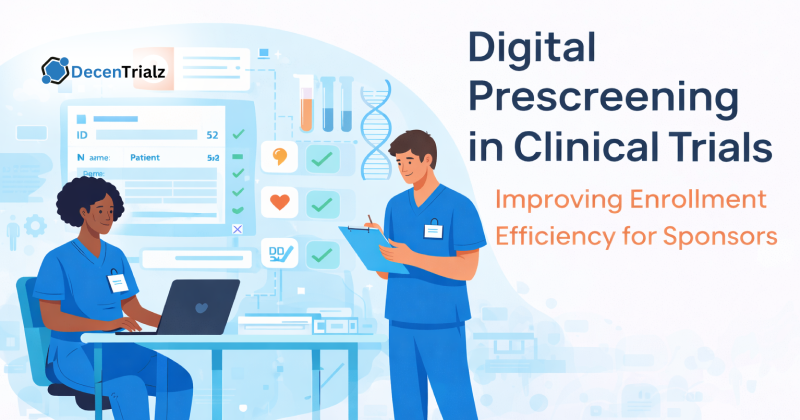
    Digital prescreening in clinical trials has become a requirement as traditional screening methods struggle to keep pace with modern study complexity, rising protocol demands, and increasing pressure on enrollment timelines. What was once a manageable operational step is now one of the most significant sources of inefficiency for sponsors running modern clinical studies.

    Prescreening sits at the intersection of recruitment, feasibility, and site operations. When this step breaks down, the effects ripple across the entire trial lifecycle. Sponsors face delayed enrollment, rising costs, strained site relationships, and unpredictable outcomes. As protocols grow more specific and patient populations become harder to reach, manual approaches to pre-screening can no longer support sponsor expectations. When digital prescreening in clinical trials is not applied consistently, small screening gaps quickly compound into enrollment delays and rising operational costs for sponsors.

    Digital prescreening in clinical trials addresses this challenge by introducing structure, consistency, and early visibility into eligibility decisions, helping sponsors regain control over enrollment performance.

    Why Manual Pre-Screening No Longer Works

    Without digital pre-screening in clinical trials, sponsors are forced to rely on fragmented, manual workflows that cannot scale with modern protocol complexity.

    Manual clinical trial pre-screening relies heavily on emails, spreadsheets, phone calls, and individual judgment. While familiar, this approach creates systemic weaknesses that compound at scale.

    Response times are slow because coordinators must manually review each referral. Screening accuracy varies widely across sites and staff, leading to inconsistent eligibility decisions. In many cases, referrals arrive with incomplete or unclear data, forcing sites to spend additional time clarifying basic information before determining eligibility.

    The administrative burden continues to increase as coordinators juggle screening alongside regulatory, patient care, and documentation responsibilities. Feedback loops are delayed, meaning sponsors often discover screening issues only after weeks of lost time.

    As a result, clinical trial pre-screening becomes unpredictable, labor-intensive, and difficult to standardize across multi-site studies.

    The Cost of Inefficient Pre-Screening for Sponsors

    Inefficient pre-screening in clinical trials creates measurable sponsor-side consequences.

    Enrollment timelines stretch as sites filter through non-actionable referrals. Screen failure rates rise, masking poor eligibility alignment behind seemingly strong recruitment numbers. Site dissatisfaction increases when teams are overwhelmed by referrals that cannot progress.

    Sponsors also face higher operational costs. Recruitment budgets grow without corresponding enrollment gains, and internal teams spend more time troubleshooting screening breakdowns instead of optimizing study execution.

    Over time, these inefficiencies weaken sponsor-site collaboration and reduce confidence in feasibility projections for future studies.

    How High Screen-Fails Signal a Broken Pre-Screening Process

    High screen failure rates are often treated as unavoidable, but they are usually a symptom of deeper process gaps.

    When participants reach sites without proper eligibility alignment, rejections occur later in the workflow, after time and resources have already been spent. This downstream waste accumulates across sites and studies, slowing overall progress.

    Sponsors aiming to reduce screen-fails must focus on earlier intervention. Effective pre-screening in clinical trials identifies non-fit participants before they enter site workflows, preserving site capacity and protecting sponsor investment.

    Without this early filtering, screen failures remain a recurring cost rather than a solvable operational problem.

    What Digital Prescreening Changes

    Digital prescreening in clinical trials introduces structure and consistency at the earliest stage of participant evaluation, replacing subjective judgment with standardized eligibility logic.

    Digital prescreening in clinical trials introduces a structured, standardized approach to early eligibility assessment.

    Participant data is captured consistently at the first point of contact, reducing ambiguity and interpretation errors. Automated eligibility checks evaluate responses against protocol criteria before referrals are passed to sites. This allows non-eligible participants to be identified earlier, preventing unnecessary downstream effort.

    Sponsors gain real-time visibility into screening performance, while sites receive clearer, more complete referrals. The result is a cleaner handoff that reduces rework and improves operational efficiency.

    Digital Prescreening Improves Sponsor–Site Efficiency

    One of the most important benefits of digital prescreening in clinical trials is improved alignment between sponsors and sites.

    By reducing unnecessary referrals, digital workflows protect site capacity and coordinator time. Sites can focus on participants who are more likely to proceed, improving morale and engagement. Sponsors gain a more accurate view of site readiness and enrollment potential.

    This shared clarity strengthens sponsor-site trust and supports more predictable enrollment across geographies and therapeutic areas.

    The Role of Instant Match in Early Screening

    Instant match plays a practical role in early screening by helping surface participants who are more likely to align with protocol criteria.

    By rapidly comparing participant inputs against eligibility requirements, instant match reduces manual review and shortens the time between initial interest and screening outcomes. Importantly, this process supports better routing without overwhelming sites with low-quality referrals.

    Used appropriately, instant match enhances efficiency while maintaining control over site workloads.

    How Digital Prescreening Accelerates Trial Timelines

    Digital prescreening in clinical trials enables earlier readiness signals for sponsors.

    Eligibility alignment occurs closer to the top of the funnel, reducing late-stage surprises. Fewer corrections are needed once sites engage with participants, and enrollment projections become more reliable.

    This improved alignment between feasibility assumptions and real-world enrollment behavior allows sponsors to move faster with greater confidence, reducing delays and operational uncertainty.

    By embedding digital prescreening in clinical trials early in the enrollment funnel, sponsors gain clearer readiness signals and avoid late-stage corrections that slow study progress.

    How DecenTrialz Supports Digital Prescreening

    DecenTrialz supports digital prescreening in clinical trials through an RN-led prescreening model combined with a structured digital prescreening engine. Registered nurses guide early eligibility capture, validate key clinical inputs, and apply protocol-aligned screening logic before referrals reach sites. This RN-led approach improves data accuracy, reduces unnecessary back-and-forth, and ensures referrals are more site-ready from the start. By standardizing prescreening workflows and introducing early clinical oversight, DecenTrialz helps sponsors protect site capacity, reduce screening inefficiencies, and improve overall enrollment predictability without adding operational complexity.

    To learn how RN-led digital prescreening can support your trial workflows and site coordination, contact our team through the contact page.

  • Site-Patient Disconnect in Clinical Trials: Why Qualified Patients Are Still Rejected

    Site-Patient Disconnect in Clinical Trials: Why Qualified Patients Are Still Rejected

    Site-patient disconnect in clinical trials occurs when patients who appear qualified are still rejected by sites due to incomplete referrals, eligibility misalignment, or timing gaps. For sponsors, this disconnect quietly drives timeline slippage, inflates costs, and erodes trust between sponsors and research sites, even when recruitment volumes look strong on paper.

    What appears to be progress at the top of the funnel often breaks down at the site level. Patients are referred and screened, then declined, not due to lack of suitability, but because referrals arrive incomplete, poorly timed, or misaligned with site workflows and eligibility criteria. Closing this gap is essential for sponsors seeking to lower screen failures and improve sponsor-site collaboration.

    What Is the Site-Patient Disconnect in Clinical Trials?

    The site-patient disconnect in clinical trials refers to the gap between patients who appear eligible during recruitment and those who are actually site-ready when reviewed by investigators. “Qualified” in recruitment terms does not always translate to “actionable” for a site.

    Sites must verify eligibility against protocol nuances, confirm documentation, assess timing, and balance internal capacity. When referrals lack clarity or arrive at the wrong moment, sites are forced to reject patients who otherwise seem suitable. In site-patient disconnect clinical trials, the issue is rarely patient quality, it is operational readiness.

    Why Sites Reject Patients Who Seem Qualified

    Incomplete or Fragmented Referrals

    One of the most common causes of rejection is poor referral quality. Sites frequently receive referrals with:

    • Missing or outdated medical history
    • Unverified inclusion or exclusion details
    • No supporting documentation to validate key criteria

    When data arrives in fragments, sites must spend additional time chasing details. Under pressure, many sites choose to reject rather than rework referrals. Improving referral quality reduces this friction and increases acceptance rates.

    Misinterpretation of Clinical Trial Eligibility Criteria

    Clinical trial eligibility criteria are often complex and open to interpretation. Sponsors may define intent broadly, while sites apply criteria conservatively to protect compliance and efficiency.

    Common issues include:

    • Ambiguous thresholds (labs, comorbidities, prior therapies)
    • Edge cases that recruitment teams interpret optimistically
    • Differences between sponsor feasibility assumptions and site judgment

    These mismatches contribute directly to site-patient disconnect clinical trials.

    Timing Gaps and Capacity Constraints

    Even well-qualified patients can be rejected if timing is off. Patients may be referred:

    • Too early, before sites are fully activated
    • Too late, when enrollment slots are already filled
    • During periods of limited site bandwidth

    Sites operate with finite staff and competing studies. Timing gaps combined with capacity constraints turn otherwise eligible patients into screen failures.

    The Hidden Impact of Screen Failures on Sponsors

    A screen failure in clinical trial operations is not just a site-level issue, it is a sponsor cost driver. High screen failure rates in clinical trials lead to:

    • Increased cost per enrolled patient
    • Extended enrollment timelines
    • Reduced site motivation to prioritize the study

    When sites repeatedly review and reject referrals, frustration builds. Over time, high screen failure rates in clinical trials damage sponsor credibility and weaken long-term site relationships.

    Where Sponsor Expectations and Site Reality Diverge

    Sponsors often design recruitment strategies based on feasibility projections that assume smooth referral flow. In reality, sites face:

    • Limited visibility into referral readiness
    • No real-time insight into sponsor-side screening assumptions
    • Heavy workloads across multiple trials

    This divergence highlights why sponsor-site collaboration must extend beyond contracts and dashboards into how referrals are designed and delivered.

    How Poor Referral Quality Strains Sponsor–Site Relationships

    Poor referral quality creates unnecessary back-and-forth. Sites must request clarifications, sponsors must respond, and timelines stall. Over time, sites may deprioritize studies that consistently deliver unusable referrals.

    In site-patient disconnect clinical trials, relationship strain is often the first invisible casualty. Strong sponsor-site collaboration depends on referrals that respect site workflows and decision-making realities.

    Improving Sponsor–Site Collaboration Through Better Referral Design

    Effective sponsor-site collaboration starts with referral design, not volume. Key improvements include:

    • Clarifying eligibility expectations in operational terms
    • Standardizing referral data fields across studies
    • Aligning referral timing with site capacity and activation status

    When sponsors invest in cleaner, more consistent referrals, sites can act faster and with greater confidence.

    The Role of Instant Match in Reducing Site Rejections

    Instant match approaches help reduce early misalignment by ensuring that patients are assessed against core criteria before reaching the site. Used correctly, instant match:

    • Filters out clearly irrelevant referrals
    • Improves alignment with site expectations
    • Supports faster site decisions without increasing site burden

    In site-patient disconnect clinical trials, early alignment is often the difference between acceptance and rejection.

    How DecenTrialz Helps Reduce Site-Patient Disconnect

    DecenTrialz helps reduce site-patient disconnect clinical trials by improving referral accuracy and ensuring a more complete data handoff before patients reach sites. The platform supports structured referrals, clearer eligibility context, AI-driven trial matching suggestions, and RN-led pre-screening, helping sponsors lower screen failures while respecting site workflows and decision timelines.

    Learn About Referral Workflows

    Sponsors looking to reduce screen failures and improve sponsor-site collaboration can explore how referral workflows support cleaner, site-ready enrollment outcomes.

  • Rare Disease Clinical Trial Recruitment: Proven Strategies for Reaching Small Patient Populations

    Rare Disease Clinical Trial Recruitment: Proven Strategies for Reaching Small Patient Populations

    Rare disease clinical trial recruitment presents unique challenges that traditional enrollment models are not designed to solve, particularly when patient populations are extremely small, geographically dispersed, and often underdiagnosed. For sponsors and CROs, these trials are urgent due to high unmet medical need, yet they are also among the most difficult studies to execute.

    Conventional site-based recruitment methods often fall short in rare disease trials. Limited registries, delayed diagnosis pathways, and low disease awareness reduce the effectiveness of physician-only referrals. As a result, sponsors must adopt more targeted, patient-first recruitment strategies to ensure feasibility and protect trial timelines.

    Learn how DecenTrialz supports rare disease clinical trial recruitment 

    Why Rare Disease Clinical Trial Recruitment Is So Challenging

    Rare disease enrollment challenges are driven by structural constraints rather than operational inefficiencies. Most rare conditions affect a very small number of individuals, sometimes only a few hundred patients globally.

    Patients are frequently dispersed across wide geographic regions, making centralized site access difficult. Many experience long diagnostic journeys, often receiving care outside of specialty centers. Limited awareness among healthcare providers and patients further narrows the recruitment funnel, while caregivers and sites face increased logistical and administrative burden.

    The Impact of Small Patient Populations on Trial Feasibility

    Small patient populations significantly influence feasibility assumptions in rare disease trials. Enrollment projections based on site databases or historical performance are often inaccurate because eligible patients may not be actively followed at participating centers.

    Recruitment risk frequently emerges late in the startup phase, after sites are activated and timelines are committed. Without broader population-level insight, sponsors face increased delays, higher costs, and protocol amendments that could have been avoided with earlier visibility.

    Limited Registries and Underserved Communities

    Many rare conditions and diseases lack comprehensive, up-to-date patient registries. Existing registries may be fragmented, region-specific, or biased toward academic health systems, leaving large portions of the population unaccounted for.

    Underserved communities are particularly underrepresented, leading to missed feasibility signals and limited diversity. Effective rare disease clinical trial recruitment requires outreach beyond traditional sites to engage patients who are not already connected to specialty care networks.

    Why Traditional Recruitment Models Fall Short for Rare Condition Trials

    Traditional recruitment models for rare condition trials rely heavily on local investigator referrals and manual screening processes. This approach assumes that eligible patients are already diagnosed, engaged in care, and accessible through study sites.

    In practice, manual screening increases site burden and leads to high screen-failure rates. These inefficiencies slow enrollment and limit scalability, making it difficult to support complex rare disease protocols.

    Modern Strategies That Work in Rare Disease Recruitment

    AI-Powered Patient Identification

    AI plays an increasingly important role in accelerating rare disease clinical trial recruitment by identifying potential participants beyond site databases. By leveraging broader clinical and behavioral signals, AI supports earlier feasibility validation and more accurate recruitment planning.

    This approach allows sponsors to assess population availability sooner, reducing downstream enrollment risk.

    Digital Pre-Screening to Improve Referral Quality

    Digital pre-screening improves referral quality by evaluating basic eligibility before patients are referred to sites. This reduces unnecessary screen failures, protects site capacity, and respects patient time by setting clearer expectations early in the process.

    For sponsors, this results in a cleaner, more efficient recruitment funnel.

    Partnerships With Advocacy Groups and Online Communities

    Advocacy organizations play a central role in rare disease research by building trust and awareness within patient communities. Partnerships with national and global groups help sponsors reach individuals who may not be visible through clinical settings alone.

    Online communities for recruiting patients to rare disease clinical trials further extend reach by enabling education and engagement in familiar, trusted environments.

    Improving Access Without Changing Trial Design

    Improving access in rare disease clinical trial recruitment does not always require changes to the trial design itself. Many barriers arise from limited awareness, unclear eligibility criteria, and delayed engagement rather than visit logistics.

    Digital education, advocacy-led outreach, and structured pre-screening workflows help patients and caregivers understand trial opportunities earlier. By reducing confusion and unnecessary referrals, sponsors can improve participation and retention while maintaining traditional site-based study models.

    Using Real-World Data to Strengthen Rare Disease Feasibility

    Real-world data sources such as EHRs, claims data, and genetic databases provide valuable insight into rare genetic conditions. These data help improve early funnel accuracy, support better protocol-to-population alignment, and reduce late-stage recruitment challenges.

    Research initiatives from organizations such as the National Institutes of Health and global registries like Orphanet highlight the importance of structured data in rare disease planning.

    The Role of Instant Match in Rare Disease Trials

    Instant match capabilities support faster identification of potential participant fit without overwhelming study sites. Early discovery and engagement allow sponsors to assess feasibility sooner while maintaining a patient-first approach that minimizes unnecessary site workload.

    How DecenTrialz Supports Rare Disease Clinical Trial Recruitment

    DecenTrialz supports rare disease clinical trial recruitment through AI-enabled patient identification, trusted advocacy connections, digital pre-screening workflows, and cleaner referrals to research sites. The focus remains on patient-first engagement and sponsor-ready execution, without exaggerated claims or unnecessary complexity.

    Connect with DecenTrialz to improve rare-disease trial enrollment 

  • Virtual Site Audits: How CROs Are Adapting to Remote Oversight

    Virtual Site Audits: How CROs Are Adapting to Remote Oversight

    In the world of clinical trials, ensuring compliance, data integrity, and patient safety through regular site audits has always been a fundamental aspect of maintaining trial quality. However, the landscape is changing. The global shift toward remote and decentralized trial models accelerated by the pandemic, has dramatically transformed how CROs (Contract Research Organizations) manage site oversight. Virtual audits are no longer just a temporary solution; they are becoming a permanent and necessary part of clinical trial operations.

    This shift is more than a logistical adjustment; it’s a strategic evolution that can help CROs enhance trial efficiency and reduce costs, all while ensuring compliance and safety. Let’s explore how CROs are embracing virtual site audits, the tools that are enabling this transformation, and why this approach is here to stay.

    Why Audits Matter in Clinical Trials

    Ensuring Compliance, Data Integrity, and Patient Safety
    The integrity of a clinical trial depends on rigorous audits. These audits ensure compliance with regulatory standards, protect patient safety, and guarantee that data collected during trials is accurate and trustworthy. Any lapse in these areas can lead to regulatory penalties, compromised patient safety, and, ultimately, unreliable trial results.

    For CROs, maintaining the highest standards of oversight is non-negotiable. These audits not only safeguard public trust in clinical research but also protect sponsors’ investments and help ensure that a trial can proceed smoothly from start to finish.

    The CRO’s Role in Maintaining Standards

    CROs play a pivotal role in managing trial operations. Ensuring that clinical trials adhere to regulatory requirements such as GCP (Good Clinical Practice), ICH-GCP (International Council for Harmonisation of Good Clinical Practice), and FDA standards is essential. With the growing complexity of clinical trials, it’s no longer enough to rely on periodic onsite visits to ensure compliance, CROs must implement systems that allow for continuous oversight, even when physical site visits are not possible.

    The Shift to Virtual Audits: A Response to Changing Needs

    The pandemic has fundamentally altered how clinical trials are conducted. Travel restrictions and health protocols led many CROs to adopt virtual-first approaches to trial management, including remote site audits. What started as a necessity during COVID-19 has quickly evolved into a model that offers several advantages over traditional onsite audits.

    How Virtual Audits Benefit CROs and Sites 

    Virtual audits remove the logistical challenges of traveling to and from trial sites, cutting down costs and allowing for more flexible scheduling. They also offer sites the opportunity to engage with auditors without the disruption of hosting an onsite visit. This shift allows CROs to conduct audits in parallel across multiple sites, speeding up oversight and making it easier to identify potential issues before they become major problems.

    For sites, virtual audits reduce the burden of preparing for and accommodating auditors on-site. Additionally, they provide more flexibility for site staff to continue their regular duties without the interruption of an onsite audit, making them more efficient overall.

    Tools & Technologies Enabling Virtual Site Monitoring

    For virtual site audits to be effective, CROs need the right tools and technologies. The integration of secure, cloud-based platforms, real-time dashboards, and monitoring tools has made remote audits not only possible but efficient and reliable.

    Real-Time Monitoring Dashboards

    DecenTrialz provides a Real-Time Dashboard that delivers live updates on the status of clinical trials, ensuring transparency and efficiency for all stakeholders. Through this platform, Sponsors, CROs, and research sites can track participant enrollment, confirm patient eligibility, and monitor trial progress in real time.

    Cloud-Based Document Management

    Cloud platforms facilitate easy document sharing and storage, allowing auditors and site staff to access trial-related materials at any time, from anywhere. These platforms ensure that data is securely stored and easily accessible, which improves transparency and supports better decision-making during virtual audits.

    AI and Automation

    Artificial intelligence (AI) is also playing a key role in virtual site audits. By automating data analysis and identifying potential compliance risks, AI tools help auditors prioritize issues that need attention, saving time and improving the accuracy of audits. These tools also provide predictive insights, helping CROs spot trends that may indicate emerging risks, allowing for proactive management.

    Ensuring Compliance in Remote Audits: Best Practices for CROs

    While virtual audits offer numerous advantages, they also require careful management to ensure compliance and maintain data security. Here are some best practices that CROs should adopt to maximize the effectiveness of remote audits:

    Maintaining Transparency with Regulators

    Clear communication with regulatory authorities is crucial in virtual audits. CROs should ensure that all audit processes are thoroughly documented and that communications with sites are transparent. Secure digital platforms can provide an audit trail, which makes it easier to share information with regulators and ensures that the entire audit process is verifiable and compliant.

    Data Security and Handling

    Security is paramount when conducting remote audits. CROs should ensure that platforms used for audits comply with data protection regulations such as HIPAA, ISO and GDPR. These platforms should provide encryption, secure data storage, and controlled access to ensure the privacy and security of sensitive trial data.

    Clear Communication and Documentation

    Good communication is essential for a successful virtual audit. CROs should establish protocols for how audits will be conducted, how documentation will be shared, and how results will be communicated. This ensures that everyone involved knows their responsibilities and that the audit process runs smoothly.

    Monitoring Patient Safety in Real-Time

    Real-time monitoring tools should be used to track patient safety metrics, recruitment progress, and data collection, ensuring that everything is on track and compliant with regulatory standards. These tools help to quickly identify any discrepancies or safety concerns, enabling CROs to act immediately, even in a virtual environment.

    Virtual Audits Are Here to Stay

    The shift to virtual audits represents a major change in how CROs conduct trial oversight. This transformation isn’t just a temporary measure, it’s a permanent shift that offers greater efficiency, improved compliance, and reduced costs for all parties involved. As the clinical trial industry continues to embrace remote and decentralized trial models, virtual audits will remain a critical component of ensuring trial integrity.

    The Future of Remote Audits

    Looking ahead, we can expect the use of AI, machine learning, and automation in remote audits to become more widespread. These technologies will further streamline the audit process, improve efficiency, and enhance the accuracy of monitoring, allowing CROs to conduct audits faster and more effectively. Additionally, hybrid models that combine in-person and virtual audits will likely become more common, offering flexibility and ensuring the best approach for each trial.

  • How to Choose a Clinical Trial That Fits Your Health Goals

    How to Choose a Clinical Trial That Fits Your Health Goals

    How to choose a clinical trial depends on your health goals, preferences, and comfort level, and for many people, that decision can feel overwhelming at first.

    If you are exploring research studies for the first time, it is completely normal to feel unsure. You may come across unfamiliar terms, multiple study options, and questions about safety, time commitment, or what participation actually involves. The important thing to remember is that there is no single “right” or “wrong” choice. The right clinical trial is the one that feels appropriate for you.

    This guide explains how to choose a clinical trial in a clear, calm, and participant-friendly way, helping you make a confident and informed decision.

    Why Choosing the Right Clinical Trial Matters

    Choosing a clinical trial that fits your needs can shape your entire experience.

    When a study aligns with your health condition, schedule, and comfort level, participation often feels more manageable and less stressful. A good fit can help you stay engaged, informed, and supported throughout the process.

    It is also important to understand the benefits and risks of clinical trials. Benefits may include access to new treatments, additional medical monitoring, or the opportunity to contribute to future care options. Risks may include side effects, time commitments, or uncertainty about outcomes. Learning how to choose a clinical trial means weighing these factors in a way that feels balanced and right for you.

    How to Choose a Clinical Trial Based on Your Health Condition

    Your health condition is usually the starting point when learning how to choose a clinical trial.

    Clinical trials are designed around specific diagnoses, stages of illness, or medical histories. Even people with the same condition may qualify for different studies based on age, prior treatments, or other health details.

    This is why finding clinical trials can sometimes feel confusing. Two studies may appear similar but have different eligibility requirements. Understanding your own health background can help narrow your options and focus on trials that are more likely to be suitable.

    Location, Visit Frequency, and Time Commitment

    Another key part of how to choose a clinical trial is understanding what participation looks like in everyday life.

    Some studies require regular in-person visits at a research site, while others offer remote or hybrid options. Consider how far you are willing to travel, how often visits are required, and whether appointments fit comfortably into your routine.

    Time commitment matters as well. Some trials last only a few weeks, while others may continue for several months or longer. Knowing this upfront helps you decide whether a study fits your schedule and personal responsibilities.

    Understanding Trial Phase and What It Means for You

    Clinical trials are often described by phases, and understanding these phases can make choosing a study feel less intimidating.

    Phase I studies focus on safety and dosage and usually involve a smaller number of participants.
    Phase II studies look more closely at how well a treatment works while continuing to monitor safety.
    Phase III studies compare new treatments with standard care and typically involve larger groups.

    Learning how to choose a clinical trial includes understanding these phases in simple terms, so you know what level of experience and monitoring to expect.

    Sponsor Reputation and Study Oversight

    Trust plays an important role in how to choose a clinical trial.

    Sponsors are responsible for running and supporting studies, and reputable sponsors follow strict rules to protect participants. Independent ethics committees and review boards help ensure that trials are conducted fairly, respectfully, and with participant safety in mind.

    If you would like to learn more about participant protections, educational resources from the National Institutes of Health and the U.S. Food and Drug Administration explain how clinical trials are reviewed and monitored in clear, easy-to-understand language.

    Telehealth and Technology Support

    Technology has changed how people take part in clinical trials, making participation more flexible for many individuals.

    Some studies offer virtual visits, remote check-ins, or digital tools that reduce the need for frequent travel. Apps and online portals may be used to share updates, complete forms, or stay connected with study teams.

    When considering how to choose a clinical trial, think about whether telehealth and digital support would make participation easier and more comfortable for you.

    Using Matching Tools to Narrow Your Options

    Matching tools can make the process of how to find clinical trials much simpler.

    These tools help filter studies based on health condition, location, and basic eligibility details. Instead of sorting through long lists, participants can focus on options that may be relevant to their situation.

    Some platforms offer an instant match experience, allowing you to review potential studies more quickly while staying in control of your choices. You can explore available trials by condition here.

    Using matching tools can reduce confusion and help you feel more confident about how to choose a clinical trial that fits your needs.

    Questions to Ask Before Choosing a Clinical Trial

    Asking questions is an important part of learning how to choose a clinical trial with confidence. Consider asking:

    • What does participation involve on a day-to-day basis?
    • How often are visits required, and are virtual options available?
    • What support will be provided during the study?
    • Are there any costs, reimbursements, or travel considerations?
    • Can I leave the study at any time if I change my mind?

    Clear answers help you understand expectations and feel more comfortable moving forward.

    How DecenTrialz Helps Participants Find the Right Trial

    DecenTrialz helps participants navigate the process by offering guided discovery, clear study information, and a matching assistant that helps narrow options based on individual needs. The experience is designed to be calm and participant-focused, supporting informed decisions through an easy-to-use instant match process without pressure.

    Get a Personalized Trial Match

    If you are ready to explore studies that may fit your health goals and preferences, you can start with a personalized matching experience here

    For additional learning and guidance, you can explore educational articles at https://decentrialz.com/blog or review trusted participant resources from the National Institutes of Health and the U.S. Food and Drug Administration at your own pace.

  • Technology in Clinical Trials: A Simple Guide to More Convenient Participation

    Technology in Clinical Trials: A Simple Guide to More Convenient Participation

    Technology in clinical trials is changing how participants take part in research, making studies easier to understand, less time-consuming, and more flexible than ever before.

    Many people who explore clinical trials worry about long travel times, frequent hospital visits, complicated paperwork, or fitting study participation into their daily lives. These concerns are common, especially for people balancing work, family responsibilities, or ongoing health needs.

    Today, technology is not meant to make clinical trials harder. Instead, it is designed to reduce effort, improve clarity, and support participants throughout the research journey. From reviewing study information at home to using simple digital tools, modern trials focus on convenience, comfort, and understanding.

    What Does Technology in Clinical Trials Mean for Participants?

    When people hear the term technology in clinical trials, they often imagine complex systems or medical devices. For participants, however, it usually means something much simpler.

    Technology in clinical trials refers to digital tools that help people learn about studies, complete steps more easily, and stay connected with study teams. This may include viewing information online, completing forms digitally, or receiving updates without needing to visit a research site in person.

    The focus is on flexibility and clear communication, using technology that fits naturally into everyday life and allows participants to move forward at their own pace while staying informed and supported throughout the trial.

    How Technology Reduces the Burden of Participation

    One of the biggest benefits of data and technology in clinical trials is how much effort it removes from the participant experience.

    Technology can help by reducing the number of in-person visits, which saves time and travel. Digital forms replace repetitive paperwork, making it easier to complete required steps accurately. Communication tools allow participants to receive reminders, updates, and answers to questions without confusion.

    These changes directly improve the patient experience, making participation feel more manageable and less disruptive. Instead of working around the trial, the trial works around the participant.

    What Is eConsent?

    Rather than signing paper forms during a clinic visit, eConsent allows participants to read consent information online using a phone, tablet, or computer. The information is presented clearly so it can be reviewed carefully.

    How eConsent in Clinical Trials Works?

    eConsent in clinical trials allows participants to go through study details step by step. Participants can take their time, re-read sections, and ask questions before agreeing. This helps ensure understanding before any decision is made.

    Why Virtual eConsent Clinical Trials Are Easier?

    Virtual eConsent clinical trials support choice and clarity. Participants are not rushed and can review information in a comfortable setting. The process emphasizes informed decision-making, helping people feel confident about whether participation is right for them.

    How Wearables Are Used in Clinical Trials?

    Wearables are small devices, such as fitness trackers or sensors, that collect health information during normal daily activities.

    In clinical trials, wearables may be used to gather data like movement patterns, heart rate, or sleep habits. This information is collected passively, meaning participants do not need to manually record anything.

    By using wearables, trials can reduce the need for frequent clinic visits. Participants can continue with their routines while still contributing valuable information to the study.

    Remote Monitoring and Study Apps

    Remote monitoring tools and study apps help participants stay connected without added stress.

    These tools may allow participants to complete remote check-ins, receive reminders for appointments or tasks, and track symptoms through simple questions. Secure messaging features also make it easier to communicate with study teams when questions arise.

    From a participant perspective, these tools exist to guide and support, not to overwhelm. They help keep everything organized in one place, making participation clearer and more convenient.

    Real-World Examples of Technology Making Trials Easier

    Technology in clinical trials often shows up in simple, everyday ways.

    A participant may review consent materials at home instead of during a busy clinic visit. A wearable device may collect health data while the participant goes about daily activities. A study app may send reminders or updates, reducing uncertainty about next steps.

    Some platforms also offer an instant match experience, helping participants discover studies that may fit their basic information more quickly. This can make the early stages of exploration feel faster and less frustrating.

    How Technology Supports a Better Patient Experience

    A positive patient experience is built on clarity, transparency, and support. Technology helps by setting clear expectations from the beginning and reducing surprises during the study.

    Participants can access information easily, understand what is required, and feel supported throughout the process. When communication is consistent and steps are clear, people are better equipped to decide whether and how they want to take part.

    How DecenTrialz Uses Technology to Simplify Clinical Trials

    DecenTrialz uses technology in clinical trials to create a participant-friendly experience through a mobile-friendly platform, clear study information, guided eligibility steps, and faster study discovery using an instant match approach focused on simplicity and understanding.

    How Technology Helps You Explore Clinical Trials with Confidence

    Exploring clinical trials should feel clear and approachable, not confusing or overwhelming. When technology is used thoughtfully, it helps people understand study options, know what to expect, and move forward at a pace that feels right for them.

    Clear study information, guided eligibility steps, and simple digital tools allow participants to explore opportunities with confidence and fewer unknowns. Instead of feeling rushed or uncertain, people can take time to review details, ask questions, and decide what fits their needs.

    If you are interested in seeing how these tools can support your own journey, you can explore available studies by condition and eligibility through this simplified clinical trial discovery experience at DecenTrialz.

  • Clinical Trial Eligibility Explained: A Clear Guide to Inclusion and Exclusion Criteria

    Clinical Trial Eligibility Explained: A Clear Guide to Inclusion and Exclusion Criteria

    Clinical trial eligibility explained in simple terms can help you feel less confused, less anxious, and more confident when exploring research opportunities.

    For many people, understanding clinical trial eligibility is the first step toward deciding whether a study may be right for them.

    If you have ever looked at a clinical trial and wondered whether you qualify, you are not alone. Eligibility criteria can feel complicated or discouraging at first. Many people assume the rules exist to keep them out or that the process is hard to understand.

    In reality, eligibility criteria exist to protect you, ensure fairness, and support safe, high-quality research. Once you understand how eligibility works, the process becomes clearer and easier to navigate.

    What Does Clinical Trial Eligibility Mean for Participants?

    When clinical trial eligibility is explained in plain language, it becomes easier to understand how studies decide who can safely take part.

    Eligibility for a clinical trial is based on guidelines defined before a study begins. These guidelines help ensure that:

    • Participants are protected from unnecessary risk
    • Everyone is evaluated using the same standards
    • Study results are accurate and meaningful

    Eligibility is not a personal judgment. It simply reflects whether your current health information aligns with the needs of that particular study.

    Why Clinical Trials Use Inclusion and Exclusion Criteria

    Having clinical trial eligibility explained upfront helps reduce confusion and prevents unnecessary stress during the application process.

    Every clinical trial follows a detailed research plan reviewed by medical and ethics experts. Inclusion and exclusion criteria help researchers follow that plan correctly.

    Inclusion criteria describe who may take part in a study.
    Exclusion criteria describe who should not take part, usually for safety or scientific reasons.

    If you are not eligible for a study, it does not mean something is wrong with you. It only means that the study is not the right fit for you at that time.

    Inclusion and exclusion criteria are used to:

    • Reduce health risks for participants
    • Prevent avoidable complications
    • Ensure results reflect the right group of people

    Inclusion Criteria Explained in Simple Terms

    Inclusion criteria are the basic requirements you must meet to participate in a clinical trial.

    Common inclusion criteria include:

    • Age range, such as adults over a certain age
    • Specific health condition the study focuses on
    • Previous treatments, such as whether you have taken certain medications
    • Recent test results that fall within study guidelines

    Inclusion criteria and exclusion criteria work together to ensure participants are appropriate for the study and that research findings are reliable.

    Exclusion Criteria Explained Without Medical Jargon

    Exclusion criteria describe situations where participation may not be safe or appropriate.

    Being excluded does not mean you are unhealthy or unsuitable for research.

    You may be excluded if:

    • A health condition could increase risk
    • Another treatment might interfere with study results
    • The study requires a very specific health profile

    Inclusion and exclusion criteria in research are designed to protect participants and maintain the integrity of the study.

    Who Is Eligible for a Clinical Trial?

    There is no single rule for who is eligible for clinical trial participation.

    Eligibility depends on:

    • The condition being studied
    • The phase of the trial
    • Safety considerations
    • The goals of the research

    Someone eligible for one study may not qualify for another. This is normal and expected. Each clinical trial defines its own eligibility requirements.

    How Patient Fit Is Determined Before Enrollment

    Patient fit refers to how closely your health information matches a study’s requirements before enrollment.

    Early checks help:

    • Avoid unnecessary clinic visits
    • Respect your time and effort
    • Reduce frustration later in the process

    Understanding patient fit early allows you to focus only on studies that may be appropriate for you.

    How to Check Your Eligibility Before Applying

    You do not need to guess whether you qualify. The eligibility process begins with a simple form where you share basic information. A registered nurse then reviews your details and follows up with you to confirm accuracy, answer questions, and guide you on next steps. This approach helps reduce confusion and ensures your time is respected.

    Taking this step can make the process feel clearer and more manageable before you decide whether to move forward with a study. 

    This step-by-step approach keeps clinical trial eligibility clearly before any decisions are made.

    You can explore available studies here

    Common Misunderstandings About Eligibility Criteria

    “I was excluded, so I can never join a trial.”
    Eligibility varies by study and can change over time. Being excluded once does not mean you will always be excluded.

    “Eligibility is random.”
    Eligibility rules are defined in advance and applied consistently.

    “Doctors decide arbitrarily.”
    Eligibility decisions follow approved criteria, not personal opinions.

    Understanding clinical trial eligibility  clearly can help remove these concerns.

    Many of these concerns fade once you understand the clinical trial eligibility  in simple terms 

    How DecenTrialz Helps Make Eligibility Clear

    DecenTrialz helps make eligibility easier to understand through a clear, guided experience. You can explore studies, share basic information, and understand what happens next without pressure or confusion. The focus is on transparency, clarity, and respect for your decisions and time.

    Learn more about the mission behind this approach and how participant trust guides every step.

    For additional guidance, explore educational clinical trial resources designed to help you better understand research participation.

    The goal is to keep clinical trial eligibility  transparently so participants know what to expect at every stage.

  • Joining a Clinical Trial: A Clear and Confident Guide to What Participants Can Expect

    Joining a Clinical Trial: A Clear and Confident Guide to What Participants Can Expect

    Joining a clinical trial can feel unfamiliar at first, especially if you have never participated in research before. Many people feel uncertain about what will happen, how long the process takes, or whether it is safe.

    This uncertainty is normal. The good news is that joining a clinical trial follows a clear, structured, and transparent process designed to protect participants at every stage. You are always informed, supported, and free to make choices that feel right for you.

    This guide walks you through the entire journey in simple, reassuring language so you know exactly what to expect.

    For many people, joining a clinical trial is their first interaction with medical research, which is why clarity and transparency matter.

    What Does Joining a Clinical Trial Mean?

    Joining a clinical trial means choosing to take part in medical research that helps doctors and researchers learn more about treatments, medications, or ways to improve care.

    Clinical trials are carefully regulated and always voluntary. Participants are never required to continue if they feel uncomfortable, and safety is monitored throughout the study. You are given clear information before making any decisions and can ask questions at any time. There is no obligation to participate, and choosing not to join does not affect your regular medical care.

    Understanding what joining a clinical trial involves helps participants feel confident and informed before deciding.

    According to educational guidance from the National Institutes of Health, clinical trials follow structured processes designed to protect participants and ensure informed decision-making.

    Step-by-Step Overview of Joining a Clinical Trial

    The steps in clinical trials are designed to help participants feel informed, protected, and respected throughout the process.

    Step 1 – Finding a Trial That May Be Right for You

    Most people begin by searching for trials that match their health condition, location, or personal interest. Trials may be found online, through healthcare providers, or through trusted health communities.

    You can explore clinical trials by condition and basic eligibility details in one clear place, making it easier to understand available options and next steps: https://decentrialz.com/clinical-trials/condition

    first step help you find the right or matching trial for you.

    Step 2 – Eligibility Check and Pre-Screening

    Once you express interest, you may be asked a few basic questions. These often include age, general health information, current medications, or details about your condition.

    Not everyone qualifies for every study, and that is intentional. Eligibility checks protect participants and ensure the study is appropriate and safe for those involved.

    If a study is not a match, you are informed clearly and respectfully, and you may be guided toward other opportunities.

    Step 3 – Reviewing Study Information and Consent

    Before any testing or participation begins, you receive detailed information about the study. This includes what the study involves, how long it may last, possible risks, and your rights as a participant.

    This process is called informed consent. You are encouraged to take your time, ask questions, and discuss the information with family or trusted advisors if you wish.

    Agreeing to review the information does not mean you are required to participate.

    Step 4 – Screening Visits

    If you decide to move forward, screening visits may be scheduled. These visits can include health checks, lab tests, questionnaires, or conversations with study staff.

    Screening helps confirm whether the study is a good fit for you. It is important to know that screening does not guarantee enrollment, and being screened out is a normal part of clinical research.

    Step 5 – Enrollment or Next Steps

    If you meet all the study requirements, you may be officially enrolled. The research team will explain what happens next, including visits, follow-ups, and expectations.

    If you are not eligible, the decision is shared respectfully, and your time and interest are always valued. Transparency is a key part of joining a clinical trial.

    How Long Does It Take to Join a Clinical Trial?

    The timeline for joining a clinical trial varies from study to study. Some participants move through the process quickly, while others may experience longer timelines due to additional screening steps or scheduling needs.

    Delays often occur to ensure accuracy, safety, and proper review. Understanding this can help reduce anxiety and set realistic expectations.

    The time required for joining a clinical trial depends on screening steps, study design, and participant availability.

    Understanding the Patient Experience in Clinical Trials

    A positive patient experience in clinical trials is built on clear communication and ongoing support. Participants typically receive regular updates, have a clear point of contact, and are informed about what happens at each stage.

    Privacy and data protection are taken seriously, and personal information is handled securely. Participants are supported throughout the process, from the first conversation to the final follow-up.

    A positive experience while joining a clinical trial depends on communication, respect, and ongoing support.

    Common Questions Participants Have Before Joining

    Is it safe?
    Clinical trials follow strict safety guidelines and are reviewed by ethics committees before they begin.

    The U.S. Food and Drug Administration provides clear guidance on participant protections, safety monitoring, and informed consent in clinical trials.

    Can I leave the study?
    Yes. Participation is voluntary, and you can withdraw at any time.

    Will I be paid?
    Some studies offer compensation. Details are explained before you decide.

    Who do I talk to if I have questions?
    You will always have access to a study contact or nurse for support.

    How DecenTrialz Supports a Clear and Guided Participant Experience

    DecenTrialz is designed to make each step of joining a clinical trial easier to understand and less overwhelming for participants. The focus is on clarity, communication, and respect for individual choice throughout the process.

    Only basic information needed for initial pre-screening is collected, helping participants move forward without unnecessary complexity. Registered nurses follow up with participants to clearly explain study requirements in plain language and answer questions before any decisions are made.

    Participants are informed about what the next step may be before moving forward, so there are no surprises. When applicable, guidance is provided through the informed consent process to ensure participants understand their options and rights.

    Clear status updates are shared during pre-screening and referral, helping participants know where they stand at every stage of the journey.

    Learn more about DecenTrialz here:
    https://decentrialz.com/about-us

    Find a Trial That Fits You

    If you are considering participation or simply want to explore options, you can take the next step at your own pace.

    Find a Trial That Fits You
    https://decentrialz.com/clinical-trials/condition

  • Predictive Enrollment Analytics: 5 Critical Signals Sponsors Can See Before Recruitment Starts

    Predictive Enrollment Analytics: 5 Critical Signals Sponsors Can See Before Recruitment Starts

    Predictive enrollment analytics helps sponsors see enrollment risk, feasibility gaps, and recruitment readiness before recruitment officially starts. Instead of relying on static assumptions or historical averages, sponsors gain early clarity into whether a study is realistically enrollable in the markets they plan to activate.

    For many clinical trial sponsors, enrollment planning still begins with optimistic projections. Sites submit feasibility surveys, historical performance is reviewed, and enrollment targets are set months before the first participant is screened. Yet once recruitment begins, timelines slip, screen failures rise, and contingency plans trigger too late.

    The cost of these assumptions is high. Delayed enrollment extends trial timelines, inflates budgets, and creates operational pressure across sites and CRO partners. Predictive enrollment analytics shifts this risk window earlier, when sponsors still have the ability to adjust strategy with minimal downstream disruption.

    See How Sponsors Gain Early Enrollment Control

    What Is Predictive Enrollment Analytics?

    Predictive enrollment analytics is a data-driven approach that models how enrollment is likely to perform before recruitment begins. Instead of asking sites how many patients they believe they can enroll, sponsors evaluate real-world signals that indicate whether enrollment is feasible at all.

    Unlike traditional feasibility assessments, predictive modeling focuses on observable indicators, not self-reported optimism.

    Published research has shown that predictive modeling can improve enrollment planning accuracy and reduce downstream recruitment delays.

    Key components of predictive enrollment analytics include:

    • Expected referrals: Estimating how many potential participants may realistically enter the funnel based on outreach reach and historical demand patterns
    • Conversion rates: Anticipating how many referrals will progress through screening and eligibility review
    • Anticipated drop-offs: Identifying where candidates are most likely to disengage or fail screening
    • Demographic feasibility: Assessing whether required age, condition, and comorbidity criteria align with available populations
    • Community match levels: Evaluating whether geographic and community-level factors support participation

    This approach gives sponsors feasibility insights grounded in evidence rather than assumptions.

    Why Predictive Enrollment Matters Before Recruitment Starts

    Enrollment challenges rarely appear suddenly. They are usually embedded in early planning decisions. Waiting until sites activate to discover enrollment problems leaves sponsors with limited options and higher costs.

    Predictive enrollment analytics surfaces risk before recruitment begins, when adjustments are still manageable.

    Expected Referral Volume

    Early modeling shows whether projected referral volume can realistically support enrollment targets. If referrals are insufficient on paper, they will not improve once recruitment starts.

    Anticipated Conversion Rates

    Not all referrals become participants. Predictive analytics for enrollment management estimates how many candidates are likely to qualify and consent, based on protocol complexity and historical behavior.

    Screening and Drop-Off Risk

    High screen-failure rates are often predictable. Complex eligibility criteria, long screening windows, and burdensome visit schedules increase early drop-offs. Identifying this risk early helps sponsors recalibrate expectations.

    Demographic and Community Match

    Patient enrollment in clinical trials depends on population alignment. Predictive enrollment analytics highlights mismatches between protocol requirements and real-world demographics across regions.

    Enrollment feasibility improves when protocol requirements align with real-world patient populations across conditions.

    Early Feasibility Insights vs Assumptions

    Traditional feasibility often reflects what sites hope to enroll. Predictive models focus on what is likely to enroll, giving sponsors a clearer foundation for planning.

    Predictive Analytics for Enrollment Management

    Predictive analytics for enrollment management enables sponsors to move from reactive oversight to proactive planning. Instead of responding to enrollment delays after they occur, sponsors use early signals to shape execution strategy.

    With predictive enrollment analytics, sponsors can:

    • Plan realistic enrollment pacing across sites and regions
    • Identify where enrollment risk is highest before site activation
    • Adjust site selection and geographic distribution
    • Reduce startup risk tied to underperforming locations

    At a high level, these insights align naturally with a clinical trial management system, where enrollment planning, site oversight, and timeline tracking intersect.

    What Sponsors Can See Before Site Activation

    One of the strongest advantages of predictive enrollment analytics is visibility. Sponsors gain insights that were previously unavailable until recruitment was already underway.

    Before sites activate, sponsors can see:

    • Enrollment readiness: Whether projected participant flow supports enrollment targets
    • Screening capacity risk: Early indicators of high screen-failure likelihood
    • Geographic alignment: How well selected regions match protocol demographics
    • Timeline confidence: Whether enrollment timelines are achievable or require adjustment

    This early visibility allows sponsors to intervene strategically, rather than reacting under pressure later.

    How Predictive Enrollment Reduces Downstream Delays

    Enrollment delays rarely stay isolated. They cascade into protocol amendments, site burden, and operational inefficiencies.

    By identifying feasibility gaps early, predictive enrollment analytics helps sponsors avoid:

    • Unplanned protocol changes driven by enrollment shortfalls
    • Unrealistic timelines that require repeated extensions
    • Reactive enrollment pressure that strains sites and CRO partners

    More accurate forecasting leads to smoother execution and stronger alignment across all stakeholders involved in clinical trial enrollment.

    Real-Time Funnel Visibility Completes the Picture

    Predictive models are most effective when they are not treated as static forecasts. Enrollment conditions evolve as outreach begins, screening starts, and participants move through the funnel.

    Pairing predictive enrollment analytics with real-time funnel visibility allows sponsors to continuously validate assumptions. Early predictions are confirmed or corrected as live data becomes available, improving confidence in enrollment decisions.

    This continuous validation ensures predictive analytics for enrollment management remains useful throughout the trial lifecycle.

    How DecenTrialz Supports Predictive Enrollment

    DecenTrialz supports predictive enrollment analytics by combining real-time funnel visibility with RN-led pre-screening, enabling sponsors to identify enrollment readiness and feasibility risks earlier in the study lifecycle.

    Sponsor Takeaway

    Sponsors who depend solely on traditional feasibility assessments often uncover enrollment risk after recruitment has already begun. At that stage, timelines slip and corrective actions become costly.

    Predictive enrollment analytics allows sponsors to surface feasibility gaps earlier, strengthen enrollment planning, and move forward with greater confidence. Seeing enrollment risk before recruitment starts supports more disciplined decision-making and more predictable trial execution.

    Explore Sponsor Capabilities