Category: Sponsors

  • How to Register a Clinical Trial in India: A Complete Step-by-Step Guide 

    How to Register a Clinical Trial in India: A Complete Step-by-Step Guide 

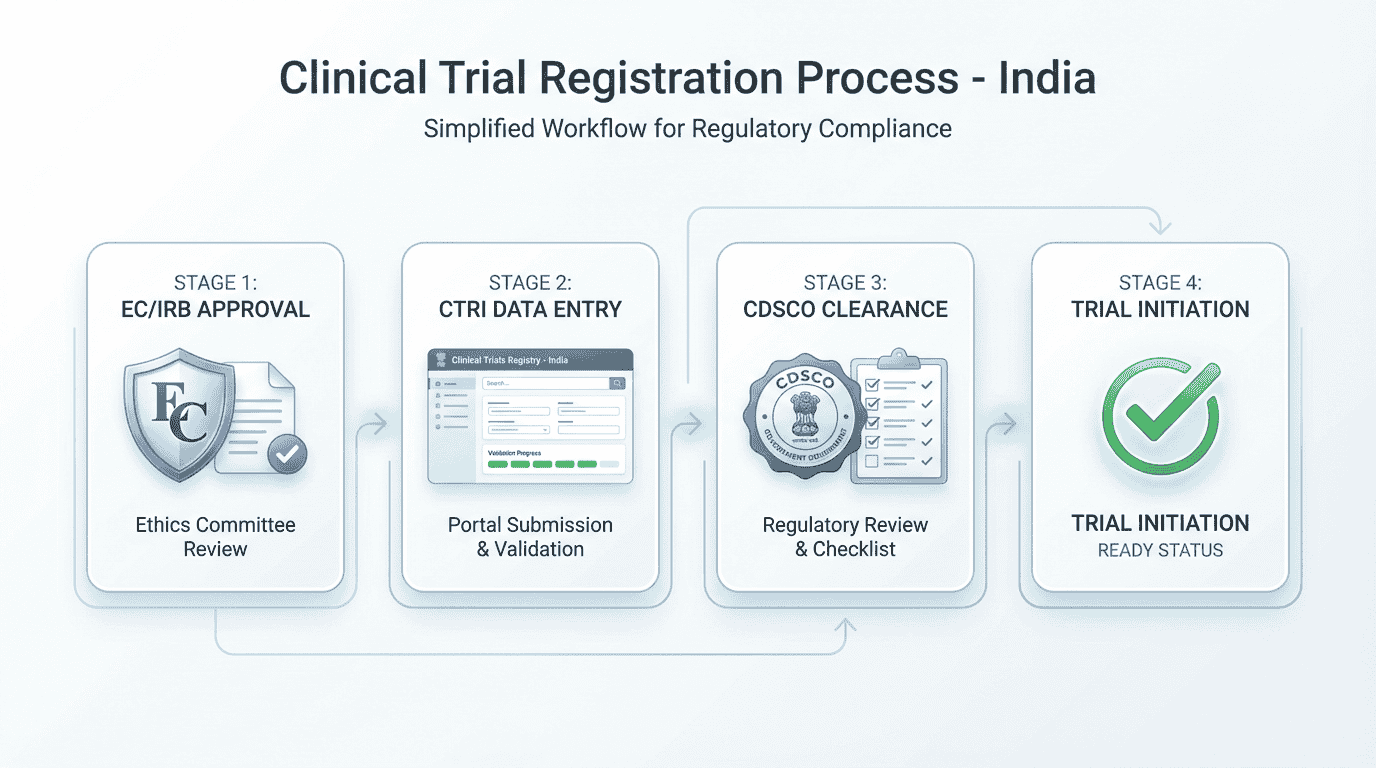
    Clinical trial registration India involves a clear, regulated sequence that every sponsor must follow before enrolling participants. Under the New Drugs and Clinical Trials Rules (NDCT Rules), 2019, registration ensures transparency, participant protection, ethical oversight, and compliance with national and global publication standards. The steps below explain the complete process in simple, structured terms.

    Strengthen early trial readiness with cleaner pre-screening workflows and organized participant intake through DecenTrialz

    Why Clinical Trial Registration Is Required

    Registration ensures:

    • Transparency of study methods and objectives
    • Participant safety and ethical oversight
    • Prevention of duplicate studies
    • Compliance with WHO and ICMJE journal requirements
    • Public availability of essential trial information

    Trials registered late may face publication barriers, regulatory concerns, or EC objections.

    Key Authorities in the Registration Process

    CTRI (Clinical Trials Registry–India)

    Public registry for prospective trial registration.
    Assigns a REF number immediately upon submission, and a CTRI Number after full review and approval.

    Ethics Committee (EC/IRB)

    Ensures participant rights and safety.
    A dated EC approval letter is mandatory at CTRI submission.

    CDSCO and DCGI

    India’s national regulatory authority responsible for approving trials involving new drugs, regulated medical devices, and certain high-risk interventions.

    Step-by-Step Registration Process for Sponsors

    The steps below reflect NDCT Rules 2019, updated CDSCO processes, current CTRI expectations, and SUGAM portal requirements.

    Step 1: Prepare the Clinical Trial Protocol

    The protocol is the foundational document describing:

    • Study purpose and design
    • Eligibility criteria
    • Number of participants
    • Interventions
    • Visit schedules and assessments
    • Safety oversight strategy
    • Data analysis plan
    • Insurance and compensation provisions

    Sponsor tasks:

    • Finalize protocol with version number and date
    • Ensure consistency across informed consent forms, case report forms, and all supporting documents

    Step 2: Prepare Participant Documents

    Participant-facing documents must be clear and easy to understand.

    These include:

    • Participant Information Sheet (PIS)
    • Informed Consent Form (ICF)
    • Translated versions (if required)

    These documents must explain:

    • Purpose
    • Procedures
    • Risks and benefits
    • Voluntary nature of participation
    • Privacy protection
    • Compensation for study-related injury

    Step 3: Submit the Study to the Ethics Committee (EC/IRB)

    The EC/IRB reviews:

    • Protocol
    • PIS/ICF
    • Investigator’s Brochure
    • Case report forms
    • Site suitability details
    • Investigator CVs
    • Insurance and compensation documents

    Regulation Update

    Under NDCT Rule 19(5), EC review may occur in parallel with CDSCO review, but:

    • CTRI requires dated EC approval letters at the time of submission, and
    • CDSCO issues final permission only after EC approval.

    Timeline: Commonly 2–6 weeks, depending on EC schedules.

    Sponsor tasks:

    • Ensure EC approval letters contain correct protocol title, version, site name, and approval date
    • Maintain approvals for all participating sites

    Step 4: Determine Whether CDSCO Approval Is Required

    A corrected and accurate decision table for 2025:

    ScenarioCDSCO Approval Required?Notes
    New drug / Investigational New Drug (IND)✔ YesRequires Form CT-04 via SUGAM
    Global clinical trial where product is IND or regulated✔ YesIND/global new drug studies require CDSCO approval
    Global trial using an approved, marketed drug without new claims✖ Often Not RequiredPurely post-marketing observational global studies may be exempt
    Bioavailability / Bioequivalence (BA/BE) study of regulated drug✔ Yes45-day review timeline
    Medical device trial (regulated categories)✔ YesAs per device risk class
    Pure observational study with no intervention✖ Not RequiredCTRI still encourages registration when unclear

    CDSCO Submission Includes:

    • Application via SUGAM Portal
    • Form CT-04 (for permission to conduct a clinical trial)
    • Fee payment through Bharatkosh
    • Protocol + Investigator’s Brochure
    • CMC and safety data (if applicable)
    • Preclinical or prior clinical data
    • EC approval before final permission
    • PI and site information
    • Compensation and insurance documentation

    CDSCO Review Timelines (NDCT Rules)

    • New drug clinical trials: Up to 90 days
    • BA/BE studies: Up to 45 days

    Sponsor tasks:

    • Register on SUGAM with Digital Signature Certificate
    • Upload documents in required formats
    • Respond promptly to CDSCO queries

    Step 5: Collect All CTRI-Required Information

    Information needed for CTRI:

    • Study titles
    • Health condition
    • Study type and design
    • Phase of study
    • Inclusion/exclusion criteria
    • Objectives and outcome measures
    • Sample size (total + per site)
    • Recruitment timelines
    • PI and site details
    • Dated EC approval letters
    • CDSCO approval details (if applicable)
    • Sponsorship details

    Documents needed:

    • EC approval letter(s) (dated and signed)
    • CDSCO approval letter (if required)
    • Final protocol
    • PIS and ICF
    • Investigator CVs
    • Insurance and compensation documents

    Step 6: Create a CTRI Account

    Actions include:

    • Register on ctri.nic.in 
    • Provide PI or responsible contact details
    • Verify email
    • Access the online registration form

    No fee is charged.

    Step 7: Complete the CTRI Registration Form

    CTRI requires precise, consistent information.

    Important expectations:

    • Titles must match EC approval exactly
    • Site list must match EC-approved sites
    • Study phase must reflect protocol and regulatory approvals
    • Interventions must be described clearly without promotional wording
    • Recruitment dates must be realistic and consistent
    • Observational studies with even minimal intervention elements must still register

    CTRI Timeline

    • REF number assigned immediately after submission
    • Review usually starts within 10 working days
    • CTRI number assigned after clarifications and approval

    Sponsor tasks:

    • Conduct a complete internal quality check
    • Fix inconsistencies in names, dates, or versions
    • Respond quickly to CTRI clarifications

    Step 8: Post-Approval Responsibilities

    Once approved:

    • CTRI number becomes public
    • Enrollment can begin (if CDSCO and EC approvals are active)

    Updating CTRI

    Updates require contacting CTRI at ctri@gov.in to unlock the record.

    Updates needed for:

    • Adding or removing sites
    • Changing investigators
    • Amendments to protocol
    • Recruitment status updates
    • Timeline extensions

    Additional Sponsor Responsibilities (NDCT Rules)

    • Report Serious Adverse Events (SAEs) within 14 days to EC and CDSCO
    • Maintain insurance coverage and compensation compliance
    • Ensure all amendments receive EC approval

    Expected Timelines 

    StepExpected Timeline
    Protocol preparation~1–3 weeks
    EC/IRB approval~2–6 weeks
    CDSCO approval (new drugs)Up to 90 days
    CDSCO approval (BA/BE)Up to 45 days
    CTRI review~10 days initial + time for clarifications

    Common Mistakes Sponsors Should Avoid

    • Submitting CTRI form without dated EC approval letters
    • Assuming global trials always require CDSCO approval
    • Using different protocol titles across EC, CDSCO, and CTRI
    • Selecting incorrect study design or phase
    • Uploading outdated protocol or ICF versions
    • Entering site names not listed in EC approval
    • Delayed responses to CTRI or CDSCO clarifications
    • Failing to update CTRI after amendments

    Avoiding these mistakes prevents delays and ensures smooth regulatory compliance.

    Final Summary: A Clean Sponsor Roadmap

    1. Finalize protocol and participant documents
    2. Submit to EC for approval (parallel CDSCO review allowed under Rule 19(5))
    3. Determine CDSCO need using the corrected IND-based criteria
    4. Submit Form CT-04 via SUGAM if required
    5. Gather all CTRI-required documents including dated EC letters
    6. Create CTRI account
    7. Submit CTRI form and receive REF number
    8. Respond to CTRI clarifications and receive CTRI number
    9. Update CTRI through email unlock requests when needed

    This end-to-end process creates a fully compliant pathway for clinical trial registration in India, ensuring ethical conduct, regulatory readiness, and participant protection.

    DecenTrialz: Supporting Early Trial Readiness 

    DecenTrialz does not file EC submissions, CDSCO applications, or CTRI registrations.
    Those responsibilities remain with the sponsor.

    However, many registration challenges come from:

    • Inconsistent eligibility criteria
    • Unclear participant-facing materials
    • Misaligned workflows between protocol and operations
    • Poor documentation structure
    • High screen failure rates due to unclear pre-screening

    DecenTrialz strengthens early trial readiness by helping sponsors:

    • Translate protocol eligibility into structured digital pre-screeners
    • Ensure participant-facing materials are consistent
    • Reduce mismatches between protocol text and operational workflows
    • Organize participant information for cleaner site review
    • Deliver only pre-qualified participants once recruitment begins

    This improves study startup efficiency and prevents avoidable screen failures.

    Improve Trial Readiness

    Ensuring clear eligibility criteria and well-organized participant workflows makes the EC, CDSCO, and CTRI process far smoother.

    Enhance your trial readiness with DecenTrialz:

    Learn More: www.decentrialz.com
    Contact the Team: www.decentrialz.com/contact

  • How to Register a Clinical Trial in the U.S. (2026 Guide for Sponsors)

    How to Register a Clinical Trial in the U.S. (2026 Guide for Sponsors)

    Registering a clinical trial in the United States can feel complicated, especially if your team is juggling IND or IDE decisions, IRB timelines, and ClinicalTrials.gov requirements at the same time. The good news is that the process becomes far more manageable once you understand the sequence and what information each step requires.

    This guide explains the registration process in simple terms so sponsors and research teams can avoid delays and keep the study startup on track.

    (Note: This guide is informational and does not replace legal or regulatory advice. Requirements evolve, and Sponsors should always verify current regulations.)

    Key Takeaways

    You will learn:

    How DecenTrialz supports pre screening and early readiness

    When your study needs an IND or IDE

    What documents IRBs expect

    What information ClinicalTrials.gov requires in 2026

    How PRS review works

    Where sponsors often lose time

    Step 1: Determine Whether Your Study Requires FDA IND Registration

    Before planning recruitment or registration, Sponsors must determine whether an investigational product requires an Investigational New Drug (IND) application.

    What an IND Is?

    An IND is FDA’s mechanism for overseeing the safety of clinical investigations involving drugs and biologics that are new, used in new ways, or used in new combinations. The IND gives FDA the opportunity to review your plan before people are exposed to the product.

    When an IND Is Required

    Generally, an IND is needed when your study:

    • Involves a new, unapproved drug or biologic
    • Uses an approved product for a new indication
    • Changes route, dose, or regimen in a way that may increase risk
    • Tests new combinations of approved products

    Some studies (for example, certain observational or non-interventional drug studies) may be exempt, but Sponsors should document the rationale.

    Types of INDs

    • Commercial IND – submitted by a company developing a product for marketing
    • Investigator IND – submitted by an individual investigator (often academic)
    • Emergency Use IND – for urgent situations where treatment cannot wait

    Documents Typically Needed

    • Protocol
    • Investigator brochure
    • Preclinical safety data
    • Chemistry, manufacturing, and controls (CMC) details
    • Informed consent templates
    • Safety monitoring and reporting plan

    The 30-Day IND Review Period

    Once FDA receives the IND, there is a 30-day statutory review period. During this time, the Sponsor must wait 30 calendar days before initiating the study. If FDA does not place the IND on clinical hold, the IND automatically goes into effect at the end of the 30 days, or earlier if FDA explicitly gives the go-ahead.

    Enrollment may begin only after:

    • The IND is in effect (no clinical hold), and
    • IRB approval has been obtained.

    Device Studies: Brief IDE Decision Framework

    If your study involves a device rather than a drug/biologic:

    • Significant risk (SR) devices generally require an FDA Investigational Device Exemption (IDE) approval plus IRB approval before starting.
    • Non-significant risk (NSR) devices do not require a full IDE submission to FDA; they follow “abbreviated IDE” requirements and only need IRB approval, but must still meet FDA device regulations.
    • Some device studies are exempt when using approved devices within labeling or under specific regulatory criteria.

    Clarifying drug vs. device pathways early helps align the registration clinical trial sequence and documentation.

    Common Sponsor Mistakes

    • Assuming IND or IDE is “approved” rather than understanding the automatic-effect or “deemed approved” frameworks
    • Submitting incomplete safety or CMC information
    • Vague primary outcomes and unclear risk justification

    Failing to document why an IND/IDE is or is not required

    Step 2: Prepare for IRB Review — IRB Approval Steps

    An Institutional Review Board (IRB) protects participant rights and welfare. IRB approval is required in addition to FDA oversight before enrollment may begin.

    What an IRB Is

    An IRB is an independent ethics committee that reviews clinical research to ensure risks are minimized and reasonable, consent is understandable, and privacy protections are in place.

    Core IRB Submission Package

    Typical documents include:

    • Full protocol
    • Informed consent and (if applicable) assent forms
    • Recruitment materials and scripts
    • Investigator brochure or device manual
    • Safety information and risk-benefit description
    • Data protection and confidentiality plans

    Central vs. Local IRB

    • Central IRB: Often used for multi-site industry-sponsored studies, providing a single, consistent review.
    • Local IRB: Common at academic centers; may require institutional templates or policies.

    Timing and Sequencing With IND/IDE

    IRBs may review protocols while FDA is reviewing an IND or IDE, but enrollment cannot start until:

    • The IND is in effect (or IDE is approved or deemed approved for NSR devices), and
    • IRB approval is in place.

    Many IRBs expect documentation of the IND or IDE status before final approval is implemented, even if review begins in parallel.

    Common Reasons for IRB Delays

    • Consent forms lacking key risk or contact information
    • Inconsistent details between protocol, consent, and recruitment materials
    • Unclear data-handling or monitoring plans
    • Missing device risk rationale (SR vs. NSR)
    • Repeated minor wording issues that slow approval cycles

    Additional Requirement: Informed Consent Posting (Common Rule)

    For certain HHS-supported clinical trials, one IRB-approved consent form used to enroll participants must be posted on a designated federal website (such as ClinicalTrials.gov) after recruitment closes and no later than 60 days after the last study visit.

    Sponsors should plan this posting as part of their documentation timeline.

    Step 3: Register the Trial on ClinicalTrials.gov

    ClinicalTrials.gov is the primary public registry for U.S. clinical trials and the focus of many ClinicalTrials.gov guide resources.

    Who Must Register?

    There are three overlapping policy drivers:

    • FDAAA 801/ Final Rule (HHS): Requires registration of “Applicable Clinical Trials” (ACTs), generally Phase 2–4 drug and biologic trials and certain device trials; Phase 1 drug trials are typically exempt.
    • NIH Policy: Requires registration and results reporting for all NIH-funded clinical trials, regardless of phase, intervention type, or whether they are ACTs.
    • ICMJE Policy: Requires prospective registration of all “clinically directive” trials (any trial assigning human subjects to an intervention to study health outcomes) as a condition for publication.

    This means a Phase 1 drug trial might be exempt from FDAAA registration but still must register if NIH-funded or if publication in an ICMJE-aligned journal is planned.

    When Registration Is Required

    • FDAAA 801 / NIH policy: No later than 21 days after enrollment of the first participant for applicable and NIH-funded trials.
    • ICMJE: Requires prospective registration—before the first participant is enrolled.

    Sponsors intending to publish or follow common institutional standards should treat “before first enrollment” as the practical default for clinical trial registration USA.

    Key Information Needed for Registration

    Before using PRS, gather:

    • Official study title
    • Brief summary (plain language, non-promotional)
    • Study design (phase for drugs, or feasibility/IDE terminology for devices; allocation, masking, primary purpose)
    • Eligibility criteria (clear inclusion and exclusion)
    • Outcome measures with specific time frames
    • Study arms and interventions
    • Enrollment type and target sample size
    • Facility locations
    • Oversight details (IND/IDE status, FDA regulated product flags)
    • Sponsor and responsible party contacts

    Phase labels (Phase 1, 2, 3, 4) apply primarily to drug and biologic studies; device trials may use alternative descriptors (for example, feasibility, pivotal).

    Step 4:Using the Protocol Registration and Results System (PRS)

    The PRS is the web-based system that manages protocol registration and results submission.

    How PRS Works

    1. Set up an organizational account – A PRS administrator at the institution or Sponsor manages user access.
    2. Enter structured data elements – Using standardized fields for design, outcomes, eligibility, locations, and oversight.
    3. Release the record for Quality Control (QC) review – ClinicalTrials.gov staff review for clarity and completeness.

    Major vs. Advisory QC Issues

    Updated PRS procedures distinguish:

    • Major Issues: Must be corrected or addressed to meet QC criteria.
    • Advisory Issues: Suggestions to improve clarity; not strictly required but recommended.

    For results, ClinicalTrials.gov may post records within 30 days of submission even if QC review is not complete, with notations that QC review is ongoing.

    Common PRS Problems to Avoid

    • Outcome measures without specified time frames
    • Vague or overlapping primary and secondary endpoints
    • Missing locations or facility information
    • Inconsistent recruitment status vs. actual site activity
    • Overuse of abbreviations without explanation

    A concise internal checklist can prevent repeated QC cycles and keep your registration clinical trial timeline on track.

    Step 5: Understand Registration Timelines

    Thinking about sequence early prevents regulatory surprises.

    Typical Operational Sequence

    1. Determine regulatory pathway (IND or IDE; drug vs. device).
    2. Submit IND or IDE to FDA.
    3. Wait 30 days for IND to go into effect (or for IDE approval/NSR determination), unless FDA allows an earlier start.
    4. Obtain IRB approval.
    5. Register the trial on ClinicalTrials.gov using PRS.
    6. Begin enrollment only after IND/IDE is active and IRB approval is in place.

    Registration Deadlines You Must Balance

    • FDAAA / NIH: Register within 21 days after the first participant is enrolled for ACTs and NIH-funded trials.
    • ICMJE: Register before the first participant is enrolled to remain eligible for publication.

    For most Sponsors, the safest operational approach is to complete ClinicalTrials.gov registration before first enrollment, even if the law allows a 21-day window.

    Consequences of Delayed or Inaccurate Registration

    • Civil monetary penalties under FDAAA 801
    • Potential withholding of NIH funds
    • Ineligibility for publication in ICMJE-aligned journals
    • Reputational risk and reduced public trust

    Step 6: Common Errors Sponsors Should Avoid

    Across drug, biologic, and device trials, Sponsors frequently encounter similar problems:

    • Missing or non-specific primary outcome measures
    • Outcome measures without time frames
    • Ambiguous eligibility criteria that do not match the protocol
    • Incorrect or inconsistent phase or study description, especially for device trials
    • Failure to list all active locations or update when sites open or close
    • Out-of-date recruitment status (e.g., shows “Recruiting” when enrollment is closed)
    • Protocol amendments not reflected in the ClinicalTrials.gov record
    • Not posting required consent forms for certain federally supported trials

    Reviewing these items as part of a pre-release QC checklist can greatly improve the quality of your ClinicalTrials.gov record.

    How DecenTrialz Helps Simplify Trial Readiness

    DecenTrialz does not file INDs, IDEs, IRB submissions, or ClinicalTrials.gov registrations. Those responsibilities remain with sponsors.
    However, a large portion of registration challenges come from inconsistent eligibility criteria, unclear recruitment materials, or misaligned workflows.

    DecenTrialz strengthens early trial readiness by helping sponsors:

    • Translate protocol eligibility into structured digital pre screeners
    • Ensure participant facing materials are consistent
    • Reduce mismatches between protocol text and operational workflows
    • Organize participant information for cleaner site review
    • Deliver only pre qualified participants once recruitment begins

    This improves study startup efficiency and helps prevent avoidable screen failures.

    Registering a clinical trial in the United States becomes far less stressful when you follow the correct sequence. By confirming IND or IDE requirements early, preparing complete IRB materials, entering accurate information in ClinicalTrials.gov, and avoiding common mistakes, sponsors can protect timelines and demonstrate transparency.

    If you want help organizing eligibility criteria, pre screening logic, and early participant workflows before your study launches, DecenTrialz provides a structured and HIPAA compliant way to support your trial readiness.

    Learn more: www.decentrialz.com
    Contact our team: www.decentrialz.com/contact

  • Unlocking Trial Efficiency Through a Unified Clinical Data Ecosystem

    Unlocking Trial Efficiency Through a Unified Clinical Data Ecosystem

    Unified clinical trial data ecosystem strategies are becoming essential as modern trials grow more complex. Protocols are more demanding, recruitment spans multiple channels, and decentralized models shift responsibilities far beyond the research site. Yet despite this evolution, many sponsors still rely on fragmented technology stacks that limit visibility, control, and operational speed.

    Individual platforms such as EDC (Electronic Data Capture), CTMS (Clinical Trial Management Systems), eConsent, RTSM (Randomization and Trial Supply Management), payment systems, and recruitment tools all serve important functions, but they often operate in isolation. This forces sponsors to navigate disconnected datasets, inconsistent reporting, and inefficient workflows that slow down enrollment and jeopardize trial quality.

    For sponsors aiming to improve oversight, reduce timelines, and enhance data accuracy, the path forward is clear. It is time to transition from standalone tools into a unified clinical trial data ecosystem that seamlessly connects recruitment, pre-screening, site follow-up, patient interaction, and compliance workflows.

    This is not simply about connecting systems. It requires true interoperability where data flows automatically, consistently, and intelligently across the entire clinical lifecycle.

    The Challenge: Disconnected Clinical Systems Are Creating Operational Blind Spots

    Even the most well-resourced sponsors struggle with disjointed systems. As trials expand globally, the lack of data flow between platforms like:

    • Electronic Data Capture (EDC)
    • Clinical Trial Management Systems (CTMS)
    • Randomization and Trial Supply Management (RTSM)
    • eConsent tools
    • Recruitment and pre-screening systems

    creates misalignment that slows decisions and increases costs.

    Tufts Center for the Study of Drug Development (Tufts CSDD) reports that almost 80 percent of clinical trials experience enrollment delays, often driven by operational inefficiencies and fragmented workflows rather than a lack of patient interest.

    The impact is significant.

    1. Data Silos Create Delays, Errors and Slow Decisions

    EDC, ePRO, CTMS, and recruitment tools rarely sync in real time. Sites frequently re-enter information across multiple systems, while sponsors must manually reconcile data to understand patient progress. This undermines the speed and accuracy needed for proactive decision-making.

    2. Maintaining Multiple Systems Drives Up Costs

    Each platform requires individual configuration, validation, IT support, and training. Sponsors often spend millions maintaining fragmented systems and still end up with inconsistent data.

    3. Poor Site and Patient Experience Reduces Engagement

    Sites may juggle several portals for scheduling, eConsent, eligibility, payments, and data entry. Patients often need separate logins for eConsent, ePRO, and communication tools. When systems are disconnected, engagement drops and retention risk increases.

    4. Regulatory Compliance Becomes More Difficult

    When systems are disconnected, maintaining clear documentation, consistent participant records, and dependable audit trails becomes challenging for sponsors. Data scattered across multiple tools makes it harder for teams to track actions, verify information, and stay operationally prepared. A unified ecosystem brings these elements together, offering structured workflows, cleaner documentation, and centralized visibility that strengthens overall oversight, even when individual platforms are not designed as certified regulatory systems.

    Where the Real Bottleneck Begins: Recruitment, Pre-Screening and Site Follow-Up

    One of the biggest pain points for sponsors is the early patient journey. Even well-funded trials struggle with:

    • unclear lead-to-enrollment ratios
    • dropped or untracked referrals
    • duplicate pre-screening
    • inconsistent communication from sites
    • misaligned data about patient status
    • manual handoffs between recruitment vendors, nurse teams and sites

    Sponsors need a unified recruitment data clinical trials approach that connects every stage of the patient flow and provides real-time transparency into funnel performance.

    This is where a unified clinical trial data ecosystem becomes transformative.

    The Solution: A Unified Clinical Trial Data Ecosystem

    To overcome disconnected systems, sponsors must adopt a unified ecosystem where all teams operate within a harmonized data environment. The goal is not simply integrating tools. The goal is achieving full interoperability.

    Here is the difference:

    IntegrationInteroperability
    Systems connect through custom-built APIsSystems function as one ecosystem by design
    Requires manual reconciliationEliminates manual reconciliation
    Data flow delays are commonData flows instantly across all platforms
    High IT maintenanceMinimal IT oversight
    Inconsistent data formatsStandardized data structures

    True interoperability links recruitment, screening, site activity, data capture, monitoring, and compliance into one cohesive operational engine.

    How a Unified Clinical Trial Data Ecosystem Works for Sponsors

    Below is how a modern unified ecosystem improves operational clarity and speed for sponsors.

    1. Seamless Recruitment and Pre-Screening Integration

    Participants enter through digital recruitment channels and their data automatically flows into a centralized platform. Nurse teams conduct pre-screening and eligibility reviews in the same environment. Sponsors gain real-time visibility across:

    • lead conversion
    • channel performance
    • drop-off stages
    • referral timing
    • qualification metrics

    This supports more accurate forecasting and spend optimization.

    2. Real-Time Site Follow-Up and Visit Tracking

    Sites receive referrals in a structured dashboard rather than email threads. Every action such as phone attempts, scheduling, prescreen outcomes, and screen fail reasons is visible to sponsors instantly. This removes site communication gaps and improves clinical trial performance improvement.

    3. Fully Connected EDC, CTMS and RTSM

    Instead of entering the same information into multiple systems, a unified ecosystem ensures that:

    • EDC receives verified, qualified participants
    • CTMS updates trial milestones automatically
    • RTSM aligns with actual site visit schedules

    This reduces drug waste, protocol deviations, and manual reconciliation.

    4. Unified Compliance and Centralized Audit Trails

    With a connected workflow, sponsors gain clearer documentation, structured participant records, and centralized communication logs that make oversight easier. All actions related to pre-screening, referral, and site follow-up are captured in one place, reducing manual tracking and helping study teams maintain better operational visibility. This improves monitoring efficiency, supports inspection readiness from an operational standpoint, and reduces the risk of missing critical information during study execution.

    5. A Single User Interface for Sites and Patients

    Instead of accessing multiple portals, sites and patients use one platform for consent, ePRO, scheduling, payments, and communication. Research shows that a simplified digital experience can increase patient retention by 25 to 40 percent. This improvement directly benefits sponsor timelines and reduces trial dropouts.

    The DecenTrialz Advantage: A Unified Recruitment and Screening Ecosystem for Modern Sponsors

    DecenTrialz was developed to eliminate fragmentation and give sponsors a complete operational view from first participant contact to enrollment. The platform unifies:

    A Structured Pre-Screening Process From Start to Referral

    • Study requirements are organized into a clear framework
    • Participants review and complete eConsent
    • Participants answer guided pre-screening questions
    • A Registered Nurse follows up and asks study-related questions
    • Qualified participants are referred to the site

    Sponsors gain:

    Real-time visibility: Instant insights without chasing weekly reports.

    Operational efficiency: Reduced manual work and fewer errors.

    Faster enrollment timelines: Because every step of the funnel works together.

    Lower operational costs: No more system sprawl or expensive integrations.

    High-quality clinical trial data: Supporting confident and accurate decision-making.

    The Future of Clinical Trials Depends on Unified and Connected Data

    Sponsors can no longer rely on fragmented tools if they want to accelerate timelines, improve trial quality, and operate with confidence. The future of clinical research lies in unified clinical trial data ecosystems that connect recruitment, screening, site operations, EDC, CTMS, RTSM, and compliance into one seamless workflow.

    Unified environments support:

    • consistent and accurate data
    • faster decision-making
    • improved site and patient experiences
    • better compliance
    • higher enrollment performance

    It is time for sponsors to move beyond disconnected systems and adopt a unified, interoperable ecosystem that brings clarity and control back to clinical operations.

    Transform Your Trial Operations with DecenTrialz

  • Why Clinical Trials Need a Better Way — And Why DecenTrialz Exists

    Why Clinical Trials Need a Better Way — And Why DecenTrialz Exists

    Clinical trial recruitment challenges continue to slow down research across the United States, even as clinical science moves forward. Many studies still face enrollment delays, and teams end up spending extra time and money trying to stay on track. Anyone who has worked on a study knows how quickly a slow start affects everything that follows.

    This problem is not for a lack of effort. Sponsors, sites, and coordinators work hard every day. The challenge is that the overall recruitment system hasn’t kept up with how research now works. People struggle to understand studies, sites handle too much manual work, and teams often don’t have a clear view of early activity. Because of this, studies lose momentum before they even begin.

    This is why clinical research needs a smoother, clearer way to guide people from interest to qualification. DecenTrialz was created to support exactly this part of the journey.

    What Commonly Slows Down Recruitment

    Recruitment breaks down for several reasons. When you look at how people find a study, how they reach a site, and what information they receive, it becomes clear that many issues happen at the same time.

    Many people don’t know where to look

    Most people don’t know clinical trials exist. Even those who are willing to join often don’t know where to search or how to see if a study is right for them. As a result, many potential participants never enter the funnel at all.

    Study information can feel too overwhelming

    Long descriptions, medical terms, and unclear details can cause confusion. This makes people lose interest or stop halfway through, even if they might have been a good match.

    Sites carry a heavy manual workload

    Coordinators spend hours sorting through inquiries, calling participants, and checking basic criteria. These repetitive tasks slow down progress and create bottlenecks. It’s frustrating for teams who are already doing their best.

    A high number of screen-fails

    When pre-screening isn’t clear or structured, many people reach the site only to learn they don’t qualify. This wastes time for both participants and site staff.

    Study teams don’t always see the full picture

    Recruitment details are often stored in different places. When everything is scattered, it becomes hard to see progress or understand where participants drop off. These issues add up over time.

    Communication feels disconnected

    When several steps depend on different tools or manual follow-ups, delays and misunderstandings become more common. This reduces the quality of the early participant experience.

    Together, these issues slow enrollment and make it harder for studies to maintain momentum.

    Why These Problems Affect Timelines

    Once the early stage slows down, the effects spread quickly:

    • Study activities get pushed back
    • Budgets increase
    • Teams feel stretched
    • Planning becomes more difficult
    • Protocol changes become more likely
    • Sites experience extra pressure

    These delays weaken the entire timeline. A strong start helps studies maintain momentum, which is why predictable recruitment is so important.

    Why a Better System Is Needed Now

    Trials today have more specific criteria and more diverse populations to reach. People also expect a simpler digital experience. Yet the early journey still depends on old methods like phone calls, emails, and scattered tools.

    This approach worked years ago, but it no longer fits the pace of modern research. Because of this, studies need:

    • Simpler ways for people to understand studies
    • A clearer path from interest to pre-screening
    • Less manual work for sites
    • More organized information for study teams
    • A smoother overall experience

    This is what DecenTrialz aims to support.

    If you’d like to see how a clearer, more organized early enrollment process can help your studies, you can learn more about DecenTrialz on our platform page.

    How DecenTrialz Improves the Early Enrollment Process

    DecenTrialz strengthens the early part of recruitment, where most delays occur. It brings together trial discovery, digital pre-screening, and organized information in one simple experience.

    Easier ways for people to find and understand studies

    Participants can browse studies in plain language. They can quickly see what the study involves, who it’s for, and what the basic requirements are. This reduces confusion and helps more people stay engaged.

    Guided digital pre-screening

    Instead of long forms or unclear questions, participants follow a simple, structured process that helps them understand whether the study might fit them.

    AI-supported logic helps improve match quality and reduces unnecessary site visits. This reduces back-and-forth between teams and supports a smoother screening experience.

    Clear and easy-to-read enrollment information for teams

    DecenTrialz shows enrollment details in a clear way. Teams can see how many people showed interest, how pre-screening went, and how participants are moving through each step. This gives teams a cleaner overview without adding complexity.

    A smoother experience for participants

    The process is easy to understand. People know what to do next and don’t get stuck on confusing medical words. As a result, more participants complete each step.

    Built with strong security standards

    The platform follows HIPAA requirements and is ISO 27001 certified, which supports secure handling of participant information.

    Why This Approach Works for Today’s Research Needs

    A clearer and more structured early funnel helps reduce long-standing issues:

    • Participants understand studies better
    • Drop-offs decrease
    • Matches become more accurate
    • Sites save time
    • Study teams get a cleaner overview
    • Enrollment becomes steadier

    All of this helps studies maintain momentum from the very beginning.

    A Better Start Leads to Better Enrollment

    Recruitment will always be challenging, but it doesn’t have to be unpredictable. As trials grow more complex, the systems supporting them must become simpler and more organized.

    DecenTrialz was built to support this shift by improving the early part of enrollment, where clarity matters most. A better start helps studies move faster, stay on schedule, and reach the people who need them.

    Explore what DecenTrialz offers and see how our clinical trial recruitment marketplace can help you reduce delays, improve clarity, and strengthen early enrollment.

  • Why Clinical Trial Recruitment Needs a Better Foundation and How DecenTrialz Supports Sponsors

    Why Clinical Trial Recruitment Needs a Better Foundation and How DecenTrialz Supports Sponsors

    Clinical trials continue to advance scientific progress, yet the area that consistently slows development is Clinical Trial Recruitment. Even as research methods evolve, many studies in the United States struggle to enroll participants on time. Sponsors face increasing pressure to meet timelines, sites face growing administrative demands, and participants often encounter confusion before they reach a qualified pre-screening stage. DecenTrialz was established to strengthen this early part of the enrollment journey, where clarity, structure, and predictability matter most.

    Before Delays Even Begin?

    Find how DecenTrialz helps you recruit qualified and diverse patients in your clinical trial.

    The Current Recruitment Landscape for Sponsors

    Across the research industry, several well-recognized patterns affect sponsor timelines. Many potential participants cannot easily interpret study information or understand eligibility. Site staff work through high volumes of inquiries using manual tools, which slows down qualification. Sponsors often receive limited signals about early funnel activity, which makes forecasting difficult. At the same time, regulatory expectations continue to grow, particularly regarding inclusion and access.

    Studies from the FDA, NIH and respected academic institutions consistently highlight these challenges. A significant percentage of trials do not meet enrollment goals within the planned timeframe. The contributing factors include limited public understanding of clinical trials, inconsistent pre-screening processes and administrative workload at research sites. These issues influence sponsor planning and increase operational uncertainty.

    These industry-wide patterns show that the core issue is not a lack of interest in clinical research. Instead, the early recruitment infrastructure has not kept pace with modern research requirements.

    Why the Early Stage of Recruitment Matters to Sponsors

    Most of a participant’s experience occurs before a research site begins direct communication. As a result, the environment participants encounter before speaking with a coordinator significantly affects whether they proceed. If study information is unclear or fragmented, many individuals discontinue the process. This reduces the number of qualified referrals that reach sites.

    Sponsors often can’t see what is happening at the very start of the process. Because they don’t know if patients are interested or eligible, they can’t fix problems quickly. This lack of information is a big reason why studies fall behind schedule.

    Sponsors increasingly need a recruitment foundation that provides structure for participants, efficiency for sites and clarity for decision makers.

    How DecenTrialz Supports a Stronger Enrollment Foundation

    DecenTrialz was designed to address the points in recruitment that have the greatest influence on timelines. The platform is not a listing service or a traditional site-facing tool. It functions as an enrollment support system that prepares participants, reduces site burden and gives sponsors a transparent view of the early funnel.

    Guided discovery for participants

    Participants use a clear and accessible trial discovery experience that helps them understand study information in simpler terms. This reduces early confusion and increases the number of individuals who complete the initial interest stage.

    Qualified referrals for sites

    DecenTrialz screens patients before sending them to the site. We filters out the right people meet the requirements of the research. It saves the research team time and lets them focus on the patients who are actually a good match.

    Early visibility for sponsors

    DecenTrialz provide Sponsors a clear data about the patients how recruitment is performing. This helps sponsors to predict exact timelines and lets them step in early if changes are needed. We follow strict rules to keep every data safe. We are fully certified and follow all privacy laws, including HIPAA and ISO 27001.

    Designed for the Expectations of Modern Clinical Research

    Sponsors face strict rules complex problems while trying to enroll the right mix of patients. Clinical trail recruitment now depends on latest technologies that works for patients, helpful for the sites, and clear for the sponsors.

    DecenTrialz strengthens the part of enrollment that has historically lacked structure. The platform creates a more predictable pathway to qualified referrals and reduces early friction. Sponsors benefit from improved consistency, stronger site performance and earlier awareness of potential delays.

    Moving Toward More Predictable and Confident Timelines

    Recruitment remains a determining factor in whether studies progress as planned. A well-supported early funnel can significantly improve how quickly participants move from interest to qualification. When participants understand their options, when sites receive prepared referrals and when sponsors gain timely visibility, enrollment becomes more reliable.

  • AI in Clinical Trials: From Recruitment to Retention

    AI in Clinical Trials: From Recruitment to Retention

    AI in Clinical Trials is reshaping the future of medical research. When a small research team in Florida launched a new heart study last year, they were excited but nervous, just like many others starting a clinical trial. Finding the right participants had always been their biggest hurdle. Flyers, ads, and physician referrals brought in only a trickle of responses. Deadlines were slipping, and funding milestones were at risk.

    So, the team decided to try something new: an AI-powered recruitment tool. Within a few weeks, they identified twice as many eligible participants as before, including people from communities that had been overlooked in past studies. For the first time, the study stayed on track.

    Stories like this are becoming more common. AI in Clinical Trials is not about replacing people. It is about giving research teams the tools to work smarter, reach participants faster, and create a more human experience from start to finish.

    Let’s explore how AI is helping researchers move from recruitment to retention and transforming the way trials are run.

    Smarter Recruitment: Finding the Right People Faster

    Recruitment is the toughest part of most trials. Around 80% of studies struggle to enroll participants on time. Traditional methods like email blasts, brochures, or physician outreach often miss the people who might actually qualify or be interested.

    AI helps solve that. By analyzing data from electronic health records, past trials, and even local health trends, AI systems can identify potential participants who fit the criteria precisely and predict who might be most likely to respond.

    In that Florida study, the AI tool helped the team focus on patients living within a certain radius who had matching conditions. Coordinators could finally spend more time reaching out personally instead of sifting through spreadsheets.

    For sponsors, that means shorter timelines.
    For research sites, less frustration.
    And for patients, more opportunities to be part of something meaningful.

    Personalized Communication: Keeping Participants Engaged

    Finding participants is only half the job. The real challenge is keeping them involved until the end. Many people drop out because they feel disconnected, overwhelmed, or simply forgotten once the trial begins.

    AI-driven engagement tools are helping fix that. They learn each participant’s preferences and communication patterns. If someone tends to ignore morning reminders but responds better at night, the system adjusts automatically. If a participant misses a check-in, AI alerts coordinators to reach out personally.

    This kind of personalization makes participants feel seen and valued. Instead of robotic reminders, they get relevant, timely communication that supports them throughout their journey.

    When people feel cared for, retention improves and data quality does too.

    Real-Time Monitoring: Enhancing Safety and Efficiency in Clinical Trials

    Traditional monitoring happens in cycles, sometimes weeks or months apart. That delay can hide safety issues or protocol deviations.

    AI changes that by enabling real-time data monitoring. It continuously reviews information from wearable devices, eCRFs, and virtual visits to detect anomalies instantly. If a reading looks off or a trend breaks protocol, the system flags it for immediate review.

    This does not replace human oversight; it strengthens it. Monitors and CROs can focus on high-risk events instead of manually checking every data point.

    The result is safer participants, cleaner data, and fewer delays.

    Predictive Insights: Planning Smarter, Not Harder

    AI can learn from thousands of past trials to predict what might happen in new ones. It can identify which sites are likely to recruit faster, where retention might be a problem, and when timelines are at risk.

    Sponsors can use these predictive insights to choose better site locations, allocate resources more effectively, and plan recruitment campaigns with real data instead of guesswork.

    For example, one sponsor found that suburban sites consistently achieved steadier retention rates than urban centers. By shifting future studies accordingly, they reduced overall delays by nearly 30%.

    With insights like these, AI helps researchers spend less time reacting and more time improving.

    Building More Inclusive and Diverse Trials

    Diversity has always been a challenge in clinical research. Too often, studies reflect only a small portion of the population.

    AI can help bridge that gap. By analyzing anonymized population data, AI systems highlight underrepresented groups and suggest ways to reach them, whether through local health networks, digital campaigns, or hybrid study designs.

    It can even help identify social or logistical barriers, such as lack of transportation, and recommend solutions like tele-visits or mobile sites.

    This does not just make studies fairer; it makes them scientifically stronger. More diverse participation means more reliable data and treatments that work for everyone.

    The Human Factor: AI as a Partner, Not a Replacement

    There is a misconception that AI will replace the people who make trials happen. The truth is the opposite.

    AI takes care of the repetitive, data-heavy work like eligibility checks, form reviews, and scheduling so coordinators, nurses, and investigators can focus on patients and research.

    It is like having an extra set of hands that never gets tired. Human expertise, empathy, and judgment remain at the center of every decision.

    When technology handles the busywork, people have more time to do what only humans can do: build trust, explain care, and make participants feel part of something bigger.

    The Road Ahead: Ethical, Transparent, and Patient-First

    As AI becomes a bigger part of research, transparency and ethics must lead the way. Data privacy, security, and fairness are not optional; they are essential. Regulations like HIPAA and GDPR, along with emerging standards for explainable AI, ensure accountability and trust.

    Platforms like DecenTrialz are helping make that future real. By connecting sponsors, CROs, and sites with AI-driven tools for recruitment, monitoring, and retention, DecenTrialz is proving that technology can be both powerful and humane.

    It is not about making trials colder or more mechanical; it is about giving researchers and participants the clarity, connection, and confidence they deserve.

    AI in clinical trials is not just about algorithms. It is about people, the researchers, coordinators, and patients who make medical progress possible.

    From the moment someone is identified as a potential participant to the day they complete their final visit, AI is there to simplify, support, and strengthen the process.

    The future of research is not just faster; it is fairer, smarter, and more human.
    When technology and empathy work together, everyone wins.

  • Decentralized vs Centralized Trials: Choosing the Right Approach

    Decentralized vs Centralized Trials: Choosing the Right Approach

    In the world of clinical research, every decision shapes the future of medicine. For sponsors, one of the most critical choices is how a trial will be conducted: through traditional centralized models, emerging decentralized designs, or a hybrid of the two.

    This is not just an operational decision. It impacts participant engagement, site performance, timelines, costs, and ultimately, the reliability of the data. As global clinical trials collaboration grows, sponsors are under increasing pressure to select trial structures that work across borders, cultures, and regulatory systems.

    The question is: how do you decide which model is the right fit?

    A Tale of Two Trials

    Imagine two oncology studies starting at the same time.

    The first trial uses a centralized model. All participants travel to a few major research hospitals, where every visit, test, and interaction happens in person. Investigators have full oversight, and the data flows from a central point.

    The second trial opts for a decentralized model (DCT). Participants use wearable devices to track vital signs, complete e-consent on their own devices, and connect with coordinators through virtual visits. Lab samples are collected at local clinics or even at home by trained professionals.

    Both approaches have strengths. Both have weaknesses. And both tell us something about how trial design is evolving.

    Centralized Trials: Strengths and Challenges

    Centralized trials are the traditional backbone of research. They give sponsors and investigators a high level of control, with all processes managed in a single location or network of sites.

    Advantages of centralized trials include:

    • Strong investigator oversight and face-to-face participant interactions.
    • Consistency in how procedures and data are managed.
    • Easier compliance with regulatory and quality standards.

    But these strengths come at a cost.

    Challenges include:

    • Geographic barriers that limit who can participate.
    • Higher participant burden, especially for those who must travel frequently.
    • Slower recruitment and retention, particularly for rare conditions or diverse populations.

    Centralized trials are reliable, but in today’s environment of global clinical trials collaboration, they can feel restrictive.

    Decentralized Trials (DCT Models): The New Frontier

    Decentralized clinical trial models are designed with flexibility and accessibility in mind. Instead of requiring participants to come to the trial, many aspects of the trial come to the participants.

    Advantages of decentralized trials include:

    • Expanded reach, making it easier to recruit participants from different geographies.
    • Reduced participant burden through virtual visits and local data collection.
    • Real-time insights from digital health tools like wearables and apps.

    Challenges include:

    • Technology adoption, not every participant or site is comfortable with digital tools.
    • Data management complexity when information flows from multiple sources.
    • Variability in regulatory acceptance across regions.

    DCTs are not a universal solution, but they open new possibilities for inclusivity, speed, and efficiency.

    Hybrid Clinical Trials: The Best of Both Worlds

    For many sponsors, the answer lies not at one extreme but in the middle: hybrid clinical trials.

    Hybrid models combine the oversight of centralized trials with the accessibility of decentralized tools. For example, key procedures may still take place at a central site, but follow-up visits, questionnaires, and monitoring can happen remotely.

    Benefits of hybrid models include:

    • Flexibility to meet participants where they are.
    • Balance between control and convenience.
    • Improved recruitment by lowering barriers while maintaining investigator involvement.
    • Increased diversity in participant populations.

    Sponsors looking to streamline operations can leverage digital platforms like DecenTrialz to manage participant requirement and data securely across multiple sites

    Decision Frameworks for Sponsors

    Choosing between centralized, decentralized, and hybrid approaches is not about following a trend, it’s about making a strategic choice that fits the trial’s objectives. Sponsors should consider:

    1. Therapeutic area and trial phase
      Early-phase trials with complex procedures may benefit from centralized control. Later-phase trials aiming for diversity may lean toward decentralized or hybrid models.
    2. Participant profile
      Are participants widely distributed, or located near major research hubs? Do they have access to technology needed for DCT models?
    3. Regulatory environment
      Different countries may vary in how they accept decentralized methods. Regulatory harmonization is essential in global programs.
    4. Budget and resources
      Centralized trials often require higher travel support and site costs, while decentralized models may require investment in digital infrastructure.
    5. Retention goals
      Hybrid models often strike the right balance by keeping participants engaged without overwhelming them.

    By using a structured framework, sponsors can match the trial design to both scientific and human needs.

    As global clinical trials collaboration expands, the trend is clear: trial design is becoming more flexible, inclusive, and participant-centered.

    • Centralized trials will continue to play a role, especially in highly complex studies.
    • DCT models will grow, driven by digital adoption and the demand for broader access.
    • Hybrid clinical trials will likely become the dominant model, offering the adaptability sponsors need in a global research environment.

    Sponsors who embrace decision-making frameworks, invest in technology, and partner with advocacy groups will lead the way in designing trials that are both scientifically rigorous and participant-friendly.

    The choice between centralized, decentralized, and hybrid trial models is not just a logistical one. It is a choice about how research engages with people, how it includes diverse communities, and how quickly life-changing therapies reach those who need them.

    For sponsors, the challenge is real, but so is the opportunity. With thoughtful sponsor decision-making, investment in innovation, and partnerships that span borders, the future of clinical research will be defined by smarter, more inclusive designs that reflect the promise of modern science.

  • Patient Advocacy and AI: Connecting Communities to Trials

    Patient Advocacy and AI: Connecting Communities to Trials

    Patient advocacy and AI are transforming how people discover, understand, and join clinical trials. Every new treatment begins with individuals and families who decide to take part in research, often motivated by the chance to improve healthcare for others as well as themselves.

    Advocacy groups help make this possible. They translate complex scientific information into something patients can understand and trust. They explain what clinical trials are, how participation works, and what potential benefits and risks exist. For many people, advocates are the first link between curiosity and confident participation.

    Still, many who could qualify for research never hear about these opportunities. Finding the right trial, meeting eligibility criteria, and feeling comfortable enough to participate can be challenging. That is where responsible technology plays a role.

    When used thoughtfully, patient advocacy and AI together help connect people to the studies that matter to them, improve outreach efforts, and make clinical research more inclusive.

    1. The Real Role of Advocacy in Clinical Research

    Advocacy ensures that patient voices are included in every stage of medical research.

    Advocates raise awareness, support families, and help researchers understand what matters most to patients. They also make trial information easier to grasp by simplifying complex terms and explaining the process clearly.

    Without these groups, clinical research would remain difficult for many to access. Advocacy gives people the confidence to explore options that might otherwise seem out of reach.

    2. Why Many Communities Still Miss Out

    Even with progress in digital communication, there are still barriers that prevent patients from joining trials.

    Some of the most common challenges include:

    • Limited awareness: Many patients never learn that studies exist or that they qualify.
    • Accessibility: Research centers are often located far from smaller communities.
    • Complex language: Technical terminology can discourage participation.
    • Mistrust: Concerns about data use and privacy still affect decision-making.

    Addressing these issues requires more than just technology; it takes cooperation between advocacy groups, researchers, and healthcare professionals to reach people where they are.

    3. How Technology Supports Advocacy

    Modern data systems can help advocacy organizations work more efficiently without losing their personal touch.

    Patient advocacy and AI together can identify where certain health conditions are more common, track studies that are currently recruiting, and organize this data for easy sharing.

    Instead of manually searching through multiple registries, advocates can use technology to quickly find accurate information and guide patients to appropriate trials. AI handles data management while people focus on relationships and communication.

    4. Making Clinical Information Easy to Understand

    Scientific details can often feel overwhelming. Terms such as “randomized,” “double-blind,” or “placebo-controlled” can make clinical trials sound complicated or intimidating.

    AI-based tools can help simplify this information by creating summaries or visual explanations that clearly describe who the study is for, where it takes place, and what participation involves.

    When information is simple and transparent, patients are more likely to ask questions, talk to their doctors, and make decisions confidently.

    5. Using Data to Improve Diversity in Research

    Diversity in clinical research ensures that medical findings apply to everyone. Studies that include participants from different backgrounds provide more accurate, meaningful results.

    AI can analyze enrollment patterns and identify underrepresented populations. Advocacy groups can use these insights to plan outreach in areas where awareness or access is low.

    By aligning patient advocacy and AI, research becomes more balanced and representative of the real world.

    6. Building Trust Through Transparency

    Trust is the foundation of clinical participation. Patients need to know that their data is protected and used responsibly.

    Advocacy groups can strengthen that trust by working with technology platforms that prioritize data security and compliance. Explaining how information is collected, stored, and used helps patients feel more comfortable sharing it.

    Clear communication keeps participants informed and reassured throughout the process.

    7. The Role of DecenTrialz

    At DecenTrialz, our goal is to make research more accessible and transparent for everyone.

    The platform connects advocacy groups, Sponsors, and research sites through verified data and reliable search tools. It simplifies how communities find active studies and helps research teams identify where additional outreach is needed.

    By combining the strengths of patient advocacy and AI, DecenTrialz is helping research partners build stronger, faster, and more inclusive connections.

    8. Looking Ahead

    As healthcare continues to evolve, patient advocacy and AI will remain central to making research more inclusive and efficient.

    Technology can manage data, predict needs, and simplify complex information, but people are the ones who turn that information into meaningful progress.

    When advocates, researchers, and technology teams work together, clinical trials become easier to access, easier to understand, and more representative of the communities they serve.

    Progress in clinical research depends on collaboration. Researchers bring science and structure, while advocacy groups bring awareness and understanding.

    When these efforts come together with the support of responsible technology, clinical trials reach more people and deliver better outcomes.

    At DecenTrialz, we continue to focus on making research participation simpler, safer, and more connected for everyone involved.

  • AI Tools for CROs and Sponsors: Streamlining Clinical Trials

    AI Tools for CROs and Sponsors: Streamlining Clinical Trials

    AI tools for CROs and Sponsors are transforming how modern clinical trials are planned, managed, and delivered. Running a clinical trial has never been simple. There are hundreds of moving parts: protocols to follow, sites to manage, patients to recruit, and data to keep accurate. Every step depends on another, and even a small delay can affect the entire study.

    For Sponsors and Contract Research Organizations (CROs), keeping everything on schedule has always been a challenge. The goal is simple: move faster without compromising on quality or compliance.

    That is where artificial intelligence makes a difference. Once considered futuristic, AI is now helping clinical research teams work smarter, not harder. When used responsibly, AI tools for CROs and Sponsors improve efficiency, reduce risks, and free people to focus on what matters most, better science and safer outcomes for patients.

    Let’s look at how these tools are changing the way Sponsors and CROs design, monitor, and deliver clinical trials.

    1. Smarter Study Planning

    Before a single patient is enrolled, months of preparation go into designing a study. Teams must estimate timelines, select endpoints, and predict enrollment rates. Getting these details wrong can delay a trial before it even starts.

    AI tools for CROs and Sponsors help analyze data from past trials to identify realistic patterns and challenges. They can predict where recruitment might slow down, how inclusion criteria might limit enrollment, or which sites could face performance gaps.

    Instead of starting from scratch, teams begin with insights that make planning clearer, faster, and more effective.

    2. Better Site Selection

    Finding the right sites can make or break a study. A site with the right infrastructure and investigator experience can keep trials running smoothly, while an unprepared site can cause costly delays.

    AI-powered platforms now use historical data, location analytics, and patient demographics to suggest the most suitable research sites. They can also highlight new potential locations that support diversity and inclusion goals.

    This allows Sponsors and CROs to build stronger site partnerships based on data, not just intuition.

    3. Making Recruitment More Human and Efficient

    Recruitment delays remain one of the biggest challenges in clinical research. Many studies take longer than expected simply because they struggle to reach eligible participants.

    AI tools for CROs and Sponsors simplify this process by identifying potential participants faster. They analyze electronic health records, patient registries, and public data to match the right people with the right studies.

    But while technology speeds up the search, it is the human connection that earns trust. Research teams that combine digital insights with empathy see higher participation and retention rates.

    4. Real-Time Oversight and Monitoring

    Traditional monitoring requires frequent on-site visits and manual data review, which can be time-consuming and expensive.

    Modern tools now make it possible to monitor study data continuously. Systems automatically flag unusual patterns, errors, or missing entries as soon as they appear.

    This proactive oversight helps Sponsors stay compliant and enables CROs to focus their resources where they are needed most. It supports Risk-Based Monitoring (RBM), where teams focus on high-risk areas instead of treating every site the same way.

    5. Cleaner, Faster Data Management

    Clinical trials generate massive amounts of data from multiple sources. Keeping it organized and consistent is essential for reliable outcomes.

    Smart management tools can detect duplicates, fix inconsistencies, and integrate information across systems. For CROs and Sponsors, that means faster reporting, fewer manual corrections, and cleaner data ready for submission.

    With these systems in place, researchers can spend less time cleaning spreadsheets and more time analyzing real insights.

    6. Predictive Planning and Early Problem Detection

    AI is not only about automating tasks, it is about seeing what might happen next.

    Predictive analytics can spot trends before they cause trouble. It can alert teams to slow recruitment, identify potential supply delays, or signal when a site’s performance is slipping.

    For Sponsors, that means smarter budget and timeline management. For CROs, it means they can act early instead of reacting late.

    7. Stronger Collaboration Between Sponsors and CROs

    Good communication between Sponsors and CROs is key to every successful trial. In the past, much of this happened through scattered files, emails, or meetings.

    Today, shared dashboards and centralized workspaces make collaboration seamless. Both sides can track progress, share updates, and make data-driven decisions in real time.

    AI tools for CROs and Sponsors help create transparency and accountability, so every step of the process stays visible and aligned.

    8. Looking Ahead

    The clinical research world is evolving quickly. Studies are more global, more digital, and more complex than ever before.

    AI will continue to play an important role in helping research teams stay efficient and compliant. But success depends on how these tools are used, responsibly, ethically, and always with patients at the center.

    Technology alone cannot replace experience or empathy. The best outcomes happen when people and systems work together toward a shared purpose: advancing science and improving lives.

    CROs and Sponsors drive the future of clinical research. Their work requires precision, coordination, and trust.

    AI tools for CROs and Sponsors do not replace human expertise, they enhance it. They reduce repetitive work, uncover insights faster, and strengthen collaboration across every stage of the trial. At DecenTrialz, we believe the right technology should make research simpler and more transparent while keeping people at the heart of every study. When innovation and human insight come together, trials become faster, fairer, and more reliable for everyone involved.

  • Myths vs Reality: The Truth About AI in Clinical Trials

    Myths vs Reality: The Truth About AI in Clinical Trials

    AI in Clinical Trials is reshaping the future of medical research. For decades, clinical studies have been the heartbeat of medical progress, yet the process has remained slow, expensive, and buried in paperwork. Today, Artificial Intelligence (AI) is stepping in to transform how we design, recruit, and manage studies with greater accuracy and speed.

    But with this transformation comes a swirl of myths. Many worry that AI will “replace humans,” make trials less personal, or even introduce bias. The truth? AI isn’t replacing the human touch; it’s helping the people behind the science do their jobs better.

    Let’s break down the most common myths and uncover the real story behind AI in clinical research.

    Myth #1: “AI will take over and replace human researchers.”

    Reality: AI isn’t taking over, it’s teaming up.

    Think of AI as a highly skilled assistant, not a replacement for human judgment. It helps researchers process massive volumes of data faster, identify patterns, and flag potential risks, but the final decisions still come from human experts.

    At one mid-sized oncology research site in Boston, the team was struggling to keep up with eligibility checks for new participants, reviewing hundreds of EHRs (Electronic Health Records) each week. After integrating an AI-based pre-screening tool, what used to take three days now takes just a few hours.

    Did the system replace the staff? Not at all. It freed them to focus on conversations with patients, physician outreach, and protocol planning, the things that require human empathy and understanding.

    AI brings efficiency; people bring context and compassion. Together, they form the perfect partnership.

    Myth #2: “AI makes clinical trials less personal.”

    Reality: It actually helps make trials more patient-centered.

    One of the biggest challenges in clinical research has always been patient recruitment. Many participants drop out not because of the science, but because they feel disconnected or overwhelmed.

    AI-driven tools can change that. They help match patients to trials that truly fit their medical and personal needs, analyze social determinants (like transportation or distance to sites), and even personalize communication timing, ensuring that participants feel understood, not just enrolled.

    Imagine Sarah, a 52-year-old living in rural Ohio, who struggled to find a trial for her rare autoimmune condition. Traditional outreach never reached her town. But when a local site started using an AI-driven recruitment platform, Sarah got a text about a study nearby that matched her health profile. She joined and later said it felt like “someone finally saw me.”

    That’s what AI can do: make research more human by helping us see every individual who might benefit.

    Myth #3: “AI introduces more bias into clinical research.”

    Reality: AI can actually reduce bias when used responsibly.

    It’s true that if AI systems are trained on biased data, they can perpetuate inequalities. But the clinical research community is already addressing this by setting strict data standards and transparency protocols.

    Today, AI models used in healthcare must undergo validation, bias testing, and regulatory oversight. Many platforms, including DecenTrialz and others leading the movement, prioritize ethical AI frameworks aligned with HIPAA, GDPR, and FDA guidance.

    Used properly, AI can highlight underrepresented populations, uncover gaps in recruitment diversity, and help ensure that trial outcomes reflect everyone, not just the majority group.

    In other words, AI isn’t the problem; it’s part of the solution.

    Myth #4: “AI is too complex and expensive for smaller sites.”

    Reality: Cloud-based and modular AI tools are now more accessible than ever.

    A few years ago, AI systems were costly and required in-house data teams. But today, SaaS-based AI platforms can integrate directly with existing clinical trial management systems (CTMS), electronic data capture (EDC) tools, or even spreadsheets.

    At a small research site in Texas, a team of five staff members struggled to track follow-ups and reminders for participants. By adopting a lightweight AI assistant that automated communication, they reduced missed appointments by 40 percent without hiring extra help or buying complex software.

    Small sites are discovering that AI doesn’t have to mean “high tech.” It can mean “smart tech that fits your workflow.”

    Myth #5: “AI can predict everything about a trial.”

    Reality: AI is powerful, but it’s not magic.

    AI helps forecast potential recruitment bottlenecks, estimate patient drop-off rates, and even detect early safety signals. But it can’t guarantee outcomes.

    Just as weather forecasts rely on models, so does AI in clinical trials. The more quality data it has, the better the predictions. But unexpected human behaviors, regulatory changes, or new medical discoveries can still shift the picture.

    Think of AI as a GPS for research. It helps you navigate smarter, but the driver’s still in control.

    Why the “Reality” Matters

    Every myth about AI usually stems from one thing: fear of change. But clinical research has always evolved. From paper CRFs to eConsent, from local data silos to global cloud sharing, every leap has made trials safer, faster, and more inclusive.

    AI is simply the next chapter. It’s about working smarter, not harder. It’s about giving researchers more time for science and patients more chances at hope.

    And when implemented transparently, ethically, and collaboratively, AI has the potential to make clinical trials more inclusive, efficient, and humane than ever before.

    The Future of AI in Trials: Collaboration, Not Replacement

    The future isn’t “AI vs Humans.” It’s “AI + Humans.”

    Platforms like DecenTrialz are helping make that collaboration real, connecting research teams, sites, and participants seamlessly. From matching diverse patients to the right trials to automating data capture and monitoring, the goal isn’t to replace people; it’s to empower them.

    When technology supports empathy, innovation, and inclusion, everyone wins, sponsors, sites, and most importantly, patients.

    AI in clinical trials isn’t a myth; it’s a movement.

    The real story isn’t about algorithms taking over, but about people working smarter, faster, and more compassionately with AI by their side.

    As Sarah’s story in Ohio reminds us, the future of research is both intelligent and human. And that’s the truth we can all get behind.